
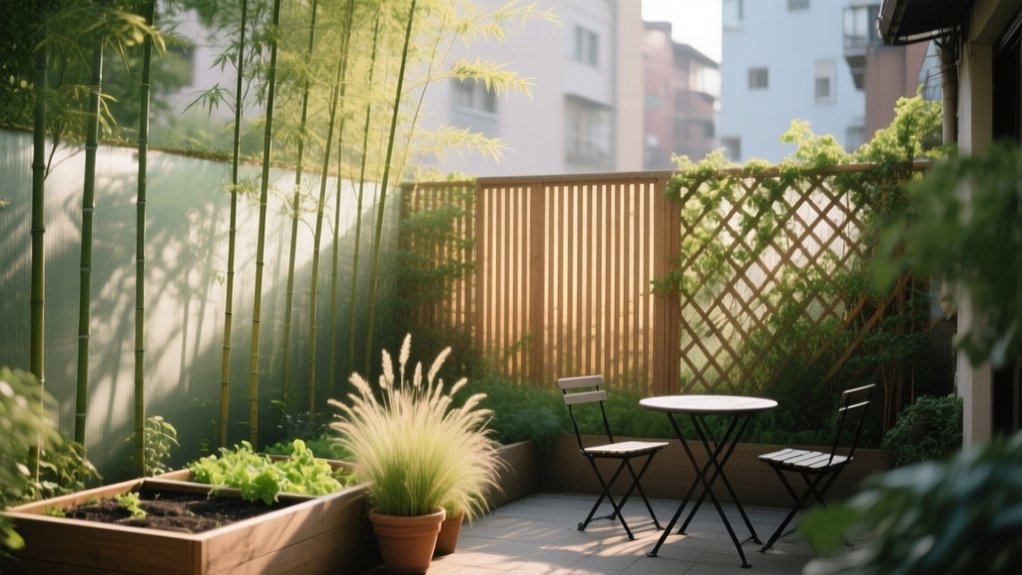

If you want seclusion outdoors but your plot risks feeling like a narrow lightwell, you’ll need to think like a designer, not just a gardener. Instead of defaulting to closeboard fencing that throws deep shade, you can work with slatted screens, pleached trees, and climbers on open trellis to interrupt sightlines while preserving daylight from the south. The way you specify materials, heights, and planting density will determine whether your garden feels cloistered or quietly secluded…
Key Takeaways
- Use open-frame structures like lattice panels or pergolas (40–60% open) to screen views while allowing sunlight and airflow.
- Plant tall, airy ornamental grasses and fine-foliaged shrubs in staggered layers to disrupt sightlines without creating dense shade.
- Train climbers such as clematis or star jasmine on trellises and arches for seasonal, dappled privacy that still lets light filter through.
- Map sun paths and neighbor sightlines, then place screens and planting precisely where needed so high-light areas remain open.
- Choose pale, matte finishes for fences and structures to reflect light back into the garden while providing a soft visual barrier.
Balance Privacy and Light From the Start
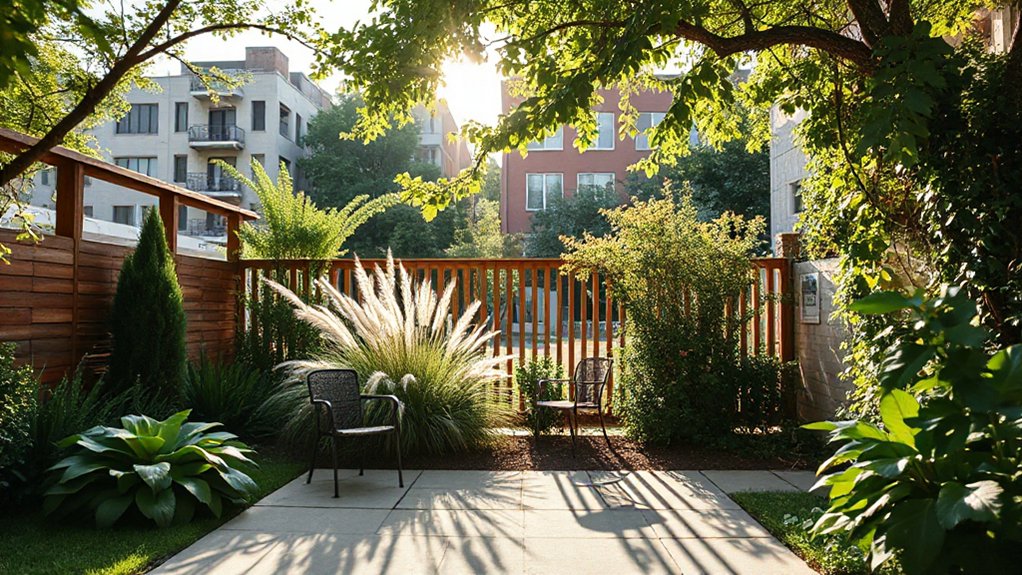
Before you choose a single fence panel or shrub, define how much privacy you actually need and when you need it, so you can design screening that preserves light levels from the outset. Map your garden layout first: mark sightlines from neighboring windows, upper decks, and public footpaths. Note where you sit for morning coffee, afternoon reading, and evening meals.
Then carry out basic sunlight management. In the UK or northern US, prioritize southern and western aspects, where low sun can be most valuable in spring and autumn. Use a sun-path sketch to record shade patterns at 9am, 1pm, and 5pm.
Identify “sacrifice zones” where you can tolerate shade, keeping prime borders and patios within high-light corridors.
Use Semi-Transparent Fences Instead of Solid Walls
Once you’ve mapped light and sightlines, the most effective structural fix is usually a semi-transparent fence rather than a solid boundary wall. Semi-transparent fencing interrupts views while still admitting high levels of diffuse daylight, preventing the corridor effect you get from brick or close-board panels.
In temperate climates like the Pacific Northwest or the UK, slatted cedar or larch with 10–20 mm gaps provides reliable privacy without overshading.
Treat these light filtering barriers as calibrated instruments: orient slats horizontally to block overlooking from neighbouring windows, or vertically to reduce bulk along tight side returns.
In hotter regions like California or Queensland, powder-coated aluminium battens or perforated steel panels resist UV, minimise maintenance, and allow cooling breezes while preserving dappled, usable garden light.
Plant Layered Hedges That Screen Without Casting Deep Shade
To create a living screen that won’t throw your garden into gloom, you’ll need to select light-permeable species and arrange them in stratified, multi-height layers.
You’ll balance fine-textured evergreens like yew, pittosporum, or Podocarpus with smaller understory shrubs and herbaceous perennials suited to your climate zone—whether that’s the Pacific Northwest, the Mid-Atlantic, or the Mediterranean coast.
Choosing Light-Friendly Species
While dense evergreens seem like the obvious choice for privacy, you’ll get far better light levels by building a layered hedge with species selected for their canopy structure, leaf density, and seasonal behavior. To balance garden aesthetics with privacy concerns, prioritize plants with fine or semi-transparent foliage and a naturally open framework.
In temperate climates, choose deciduous stalwarts like Carpinus betulus (hornbeam) or Fagus sylvatica (beech), whose marcescent leaves hold through winter, preserving screening without creating full shade.
In Mediterranean regions, opt for photopermeable evergreens such as Phillyrea, Myrtus communis, or clipped Viburnum tinus.
For North American gardens, consider Amelanchier, Aronia, and lightly pruned Thuja plicata cultivars.
Always check mature height, spread, and shade-cast patterns in local extension-service databases before committing.
Designing Multi-Height Layers
Although a single, tall hedge seems efficient, you’ll protect both privacy and daylight more effectively by organizing your screening plants into distinct vertical tiers that filter, rather than block, light.
You’re aiming for a canopy, mid-storey, and understory, much like a small woodland edge.
In a temperate UK or Pacific Northwest garden, you might combine light-canopy trees (such as amelanchier), semi-evergreen shrubs, and low perennials or ornamental grasses.
Maintain staggered spacings so gaps never align, preventing sightlines while still admitting high-angle sun.
Integrate vertical gardens on walls or fences to extend screening upwards without increasing ground footprint.
Near water features, select species tolerant of higher humidity and reflective glare, and position taller elements to intercept views, not the southern or western light.
Seasonal Interest And Cover
Layered planting does more than manage height; it also lets you engineer privacy that holds year‑round without plunging the garden into gloom. You’ll combine evergreen structure, semi‑evergreen screening, and deciduous textures so the boundary evolves but never feels exposed.
Use plants with differing phenology so gaps in one layer coincide with density in another. Position Garden sculptures and Water features where partial screening creates intrigue rather than blackout.
- Specify evergreen “bones” (yew, Portuguese laurel) for constant backdrop in temperate regions.
- Add deciduous shrubs (hazel, viburnum) that leaf out early for spring cover.
- Thread in herbaceous perennials and ornamental grasses for summer density and winter silhouettes.
- Integrate climbers on open trellis panels to veil sightlines without blocking low sun.
Add Tall, Airy Grasses for Soft, Sun-Friendly Privacy
Even in compact urban plots or sunbaked suburban yards, you can install tall, airy ornamental grasses to gain privacy without casting heavy shade. These Tall grasses act as vertical scrims, disrupting sightlines while still transmitting light, so adjacent borders remain productive, especially for Sun friendly plants and Mediterranean herbs.
Choose regionally appropriate cultivars: Miscanthus sinensis in the Mid-Atlantic, Calamagrostis × acutiflora ‘Karl Foerster’ in cooler northern zones, Muhlenbergia capillaris or Panicum virgatum in the Southeast and Plains.
Space them in staggered drifts, not rigid rows, to create a semi-opaque screen.
Prioritize clump-forming, non-invasive species, and cut them back in late winter before new growth breaks.
Install drip irrigation in arid climates to maintain vigor without promoting foliar disease.
Train Climbers on Open Structures for Dappled Seclusion
When you train climbers over pergolas, arbors, and tensioned wire frames, you create vertical privacy that filters views rather than blocking them outright. You’re exploiting climbing structures and open frameworks to engineer “dappled seclusion” that still admits high-angle sunlight.
In temperate regions, pair deciduous vines with south- or west-facing spans to moderate summer glare while admitting winter light.
- Select region-suited climbers: wisteria in the Northeast, star jasmine in the Southeast, clematis in the Pacific Northwest, grapevine in Mediterranean climates.
- Fix stainless tension wires or mesh panels at 20–30 cm intervals for secure twining and tying-in.
- Spur-prune annually to maintain layered foliage, airflow, and bloom.
- Stagger species with different leaf textures to disrupt direct sightlines without creating heavy shade.
Create Privacy With Screens, Panels, and Pergolas
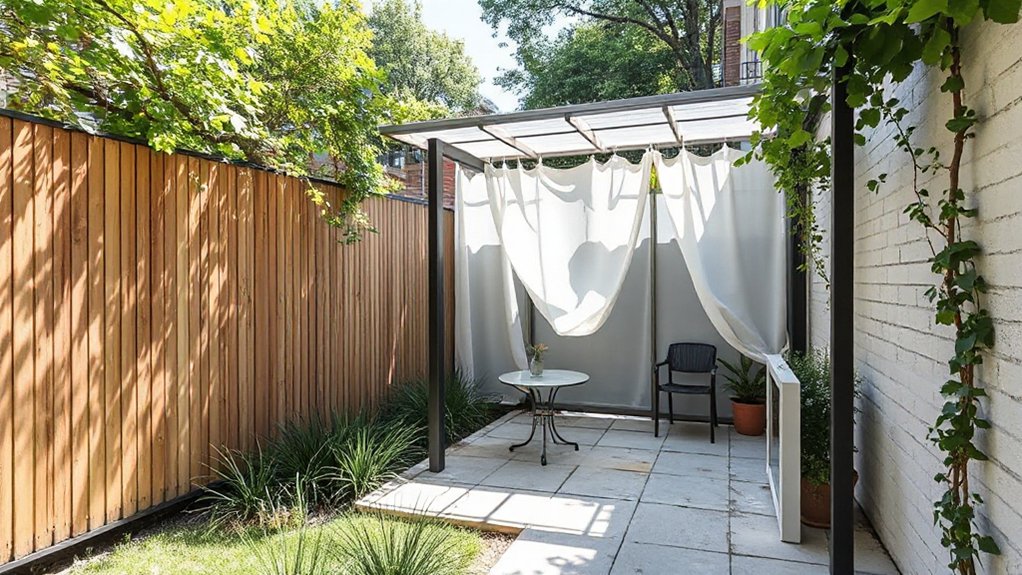
You can use architectural screening—such as decorative lattice panels and open-frame pergolas—to create enclosure without sacrificing sunlight.
Specify lattice with precise aperture sizes so it obscures sightlines while still letting low-angled winter light through, whether you’re in a compact London terrace or an exposed California backyard.
Decorative Lattice Screen Ideas
Although dense fences often dominate privacy discussions, decorative lattice screens, modular panels, and pergola structures let you shield sightlines without sacrificing daylight or airflow. You use openwork patterns to break up views while preserving solar access and cross-ventilation, essential in climates ranging from the Pacific Northwest to the humid Southeast.
- Specify lattice with 40–60% openness to balance privacy and illumination, adjusting aperture size for your sun path and prevailing winds.
- Train vine growth—like clematis or star jasmine—through the grid to create a living scrim that thickens seasonally.
- Choose laser-cut metal panels with regional decorative motifs (e.g., art deco in Miami, Federation patterns in Sydney) for architectural continuity.
- Mount screens on steel posts with concealed fixings for structural rigidity and a clean, modern profile.
Light-Filled Pergola Designs
Even in compact urban courtyards from London to Los Angeles, a well-detailed pergola can filter views without turning your garden into a dim tunnel. You achieve privacy by controlling sightlines, not by building solid roofs. Specify slatted rafters on a north–south orientation so sunlight tracks across the structure, creating dappled shade instead of gloom.
Integrate vertical timber or aluminum battens along exposed boundaries; stagger their spacing to obscure neighbouring windows while preserving airflow. In wetter climates like Seattle or Manchester, choose durable species such as cedar or thermally modified ash.
Use the pergola as an armature for garden art, climbing roses, or evergreen jasmine. Position it beside water features to amplify reflections and bounce additional light into shaded areas.
Shape Your Layout So Sightlines Are Hidden, Not Sunlight
When planning a privacy-focused garden, start by mapping key sightlines—from neighboring windows, raised decks, and upper-storey rooms—so you can interrupt those views with structure while leaving the sun’s path clear. Use Sightline management and sunlight preservation together: think like a surveyor, not just a gardener.
Place vertical elements where eyes travel, rather than where the sun tracks across the sky. In the UK, for example, low southern light needs open borders, while northern boundaries can take denser screening.
- Plot sun angles on a site plan for midsummer and midwinter.
- Walk the garden, crouching or standing to mimic typical viewing heights.
- Position trellises or pleached trees exactly in problem sightlines.
- Angle paths and terraces to turn seating away from overlooking windows.
Choose Containers and Balcony Ideas That Keep Spaces Bright
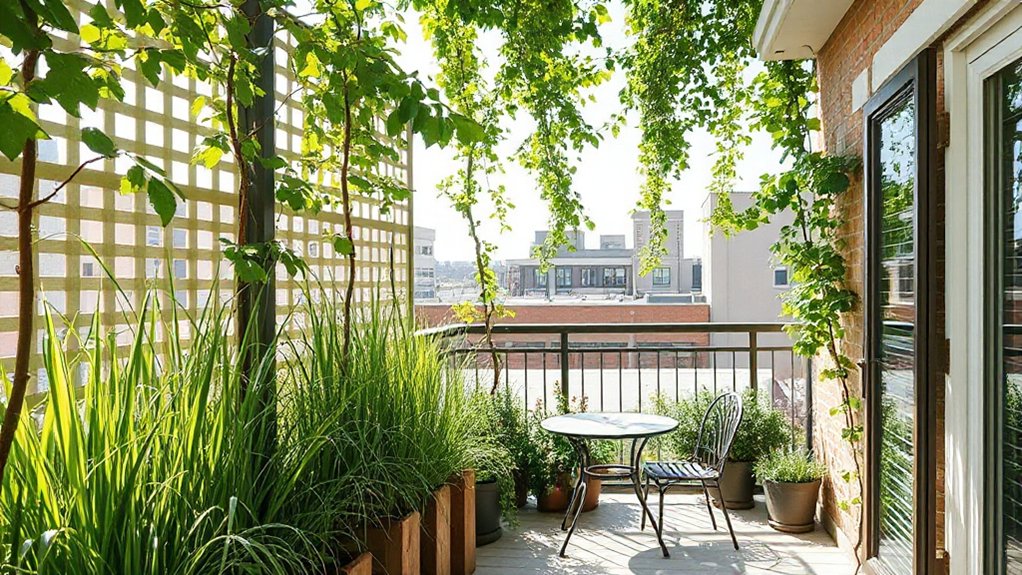
On balconies and compact terraces, you gain privacy most efficiently by treating containers and lightweight screens as adjustable “micro-walls” that sit above the parapet line without casting deep shade into the space.
Prioritise container placement along outer edges and corners, where you intercept oblique views while leaving central floor area and sky exposure open.
Use tall, narrow planters in a linear grid against Juliet or glass balcony railing styles, so you maintain daylight penetration from below.
On solid masonry balustrades, raise pots on benches or steel frames to lift foliage just above eye level, not roofline.
In windy coastal settings, such as Brighton or Cornwall, specify weighted troughs and semi-permeable planting to reduce wind load without creating a gloomy, over-screened facade.
Pick Materials, Colours, and Maintenance That Protect Your Light
Because materials and colours directly affect how much daylight reaches your terrace or garden, treat every surface as part of a light-management strategy. You’ll want finishes that reflect light, resist weathering, and sit comfortably within your region’s architectural vernacular, whether you’re in a London terrace, a Sydney courtyard, or a Toronto balcony.
- Use pale, matte fencing and trellis systems; they diffuse glare while maximising reflected light.
- Prioritise material durability: powder‑coated aluminium, galvanised steel, and Accoya or cedar outperform softwood in damp climates.
- Apply disciplined colour coordination; repeat two or three tones across pots, screens, and railings to prevent a heavy, light‑absorbing patchwork.
- Plan maintenance: schedule cleaning of glazing, repainting of timber, and sealing of stone so dirt and algae don’t dull reflective surfaces.
Frequently Asked Questions
How Can I Make a Small Urban Garden Feel More Private From Above?
You enhance overhead privacy by installing pergolas with open rafters, training vertical planting like clematis on tension wires, and positioning perforated decorative screens. In dense cities like Brooklyn or Shoreditch, integrate semi-opaque polycarbonate panels to diffuse sightlines, not sunlight.
What Are Quick Privacy Options for Renters That Won’T Damage Property?
You deploy portable screens, like freestanding bamboo panels, and you’re sorted faster than dial‑up. You also install containerized “DIY hedge ideas” using potted laurels or photinias, ensuring full reversibility and compliance with UK tenancy agreements.
How Do I Maintain Winter Privacy When Deciduous Plants Lose Their Leaves?
You maintain winter privacy by mixing evergreen hedges with sparse deciduous plants, adding vertical screens like cedar lattice or slatted metal. In colder USDA Zones, favor Thuja occidentalis, yew, or holly for dense, year‑round screening.
Can I Create Child-Friendly Private Play Areas Without Dark, Enclosed Corners?
You can, by zoning space like a patchwork quilt: specify low-height invisible fencing, perforated decorative screens, and staggered shrub masses to guarantee CPTED-compliant sightlines, soft fall zones, and child-safe, sunlit play pockets typical of suburban UK family gardens.
What Low-Allergen Plants Provide Privacy Without Aggravating Hay Fever?
You prioritize plant selection of low-pollen, insect‑pollinated species to minimize allergic response: choose Portuguese laurel, escallonia, griselinia, photinia, and New Zealand pittosporum cultivars; avoid male clones of birch, cypress, and Leylandii in UK gardens.
Conclusion
When you plan privacy like a lighting designer, you don’t just block views, you sculpt them. By using slatted fencing, layered hedging, and pergola frameworks, you create a calibrated visual barrier that still respects solar access. Think of your garden as a well-edited streetscape in London or Sydney: tall yet permeable structures, climbers, and container groupings work like translucent curtains, filtering sightlines while preserving daylight, airflow, and a spacious, contemporary feel.