
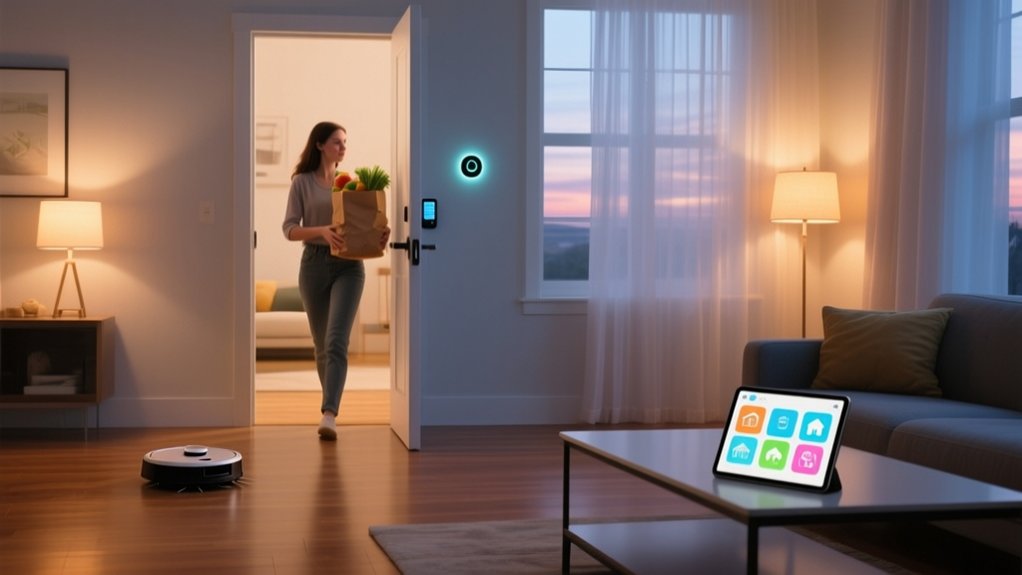

When you integrate home automation into your daily life, you’re not just adding gadgets—you’re redesigning how your space functions. Smart lighting, climate control, and connected appliances let you fine-tune comfort, security, and energy use with predictable, repeatable outcomes instead of guesswork. You shift routine tasks to automated systems that operate on your schedule and preferences. The result is a home that quietly works for you—once you know which upgrades actually matter.
Key Takeaways
- Cuts energy waste and utility bills by automatically optimizing heating, cooling, and lighting based on occupancy, schedules, and real‑time costs.
- Simplifies daily routines with automated scenes for waking, leaving, returning home, and bedtime, reducing repetitive manual tasks.
- Increases comfort through personalized climate, lighting, and entertainment settings that adapt to preferences, time of day, and weather.
- Enhances safety and security by integrating smart locks, cameras, alarms, and motion sensors into one responsive, monitored system.
- Saves time on household chores using scheduled automations, connected appliances, and robotics for cleaning, watering, and reminders.
Everyday Ways Home Automation Improves Life
When integrated thoughtfully, home automation reshapes everyday routines into streamlined, predictable workflows that reduce friction and cognitive load. You orchestrate lighting, locks, and appliances through a single interface, so repetitive actions become background processes instead of mental overhead.
You schedule garden automation to control irrigation zones based on soil moisture and weather data, ensuring plants receive precise watering while you focus on higher‑value tasks. Pet care technology dispenses food on calibrated schedules, monitors activity, and tracks environmental conditions, so you maintain consistent care even when you’re away.
You deploy automation scenes that align with specific times or triggers—waking, leaving, returning—so multiple systems respond in sync. The result is a home that quietly executes your intent with minimal manual intervention.
Making Your Home More Comfortable With Smart Devices
You can use smart devices to engineer comfort in your home with precision, rather than accepting one-size-fits-all settings.
By orchestrating personalized climate control and smart lighting ambiance, you’ll tune temperature, brightness, and color to match your activities and circadian rhythm.
When you add automated comfort routines, your environment adjusts itself throughout the day, aligning physical space with your habits and design preferences.
Personalized Climate Control
Although climate control seems like a background function in the home, smart systems turn it into a finely tuned, responsive experience that adapts to your habits and preferences in real time. You define target temperatures, humidity levels, and schedules, while adaptive algorithms learn occupancy patterns and thermal behavior in each room.
You use voice recognition to adjust settings hands-free, integrating thermostats with your preferred assistant for precise, room-specific commands. Through remote access, you monitor and modify climate profiles from anywhere, ensuring you never cool or heat an empty house.
Zoned HVAC, smart vents, and sensor networks coordinate to balance comfort and efficiency. Over time, your system predicts needs, pre-conditioning spaces before you arrive and maintaining consistent, personalized comfort with minimal manual input.
Smart Lighting Ambiance
Even subtle changes in light transform how you perceive and use each room, and smart lighting systems give you granular control over that experience. You define scenes based on task, mood, and time of day, then trigger them instantly from your phone, voice assistant, or wall controls.
By tuning color temperature, you align each space with its function: cooler whites enhance focus in work areas, while warmer tones support relaxation in living rooms and bedrooms. Layered fixtures—recessed cans, sconces, and accent lights—let you sculpt depth, highlight textures, and minimize glare.
You can program lighting schedules that adapt automatically, simulating occupancy when you’re away and providing low-level pathway lighting at night, all while optimizing energy usage and maintaining a coherent visual design language throughout your home.
Automated Comfort Routines
Instead of manually adjusting thermostats, blinds, and fans throughout the day, automated comfort routines orchestrate these systems in concert to maintain a stable, tailored environment. You define temperature setpoints, light levels, and airflow profiles, then let sensors and schedules execute them.
The system tracks time of day, occupancy, and even weather data to preemptively adapt conditions.
You can engineer personalized sleep profiles that gradually lower temperature, dim lights, and reduce noise, synchronizing with your circadian rhythm. Morning scenes raise blinds, warm the room, and cue coffee makers.
For automated entertainment, AV gear, bias lighting, and acoustic treatments trigger together when you start a movie or game. By designing these routines, you turn comfort into a predictable, repeatable system.
Saving Time on Daily Routines With Automation
You can design your home automation system to compress repetitive tasks into efficient, preset routines that reclaim hours from your day. By configuring automated morning sequences—lighting, climate, coffee makers, and notifications—you’ll standardize your start to the day with minimal manual input.
Extending this logic to streamlined household chores, you can schedule cleaning devices, laundry cycles, and even trash reminders so your home maintains itself with predictable, low-friction workflows.
Automated Morning Routines
When you architect an automated morning routine, you’re designing a repeatable sequence of triggers, devices, and conditions that shifts your home from “night” to “day” with minimal manual input. You treat the routine as a workflow: sleep optimization first, then morning productivity.
You might link your alarm to gradual lighting, thermostat ramp-up, and smart shades, all synchronized to your circadian rhythm. Sensors verify you’re awake before activating audio briefings, calibrated task lighting, and coffee preparation.
Use scene-based control: “Wake” scenes adjust light color temperature, volume, and temperature to predefined parameters. Time-based and event-based automations run in parallel, so you’re never waiting on your environment.
Over time, you refine triggers using usage data, making your mornings faster, more consistent, and cognitively lighter.
Streamlined Household Chores
Although chores seem inherently manual, a well-architected automation layer treats them as recurring processes you can offload to coordinated systems. You start by mapping each task—cleaning, laundry, garden maintenance, pet care—into discrete workflows triggered by time, sensors, or occupancy.
Robotic vacuums, mops, and window cleaners run on schedules informed by motion and dirt-detection data. Smart washers and dryers sequence cycles, send completion alerts, and integrate with energy-tariff schedules.
Irrigation controllers handle garden maintenance by adjusting watering profiles based on soil moisture and weather forecasts. In pet care, connected feeders, water fountains, and litter boxes operate from calibrated routines and health-monitoring metrics.
You orchestrate everything through a central automation hub, ensuring reliable execution, exception handling, and minimal manual intervention.
Boosting Home Security and Peace of Mind
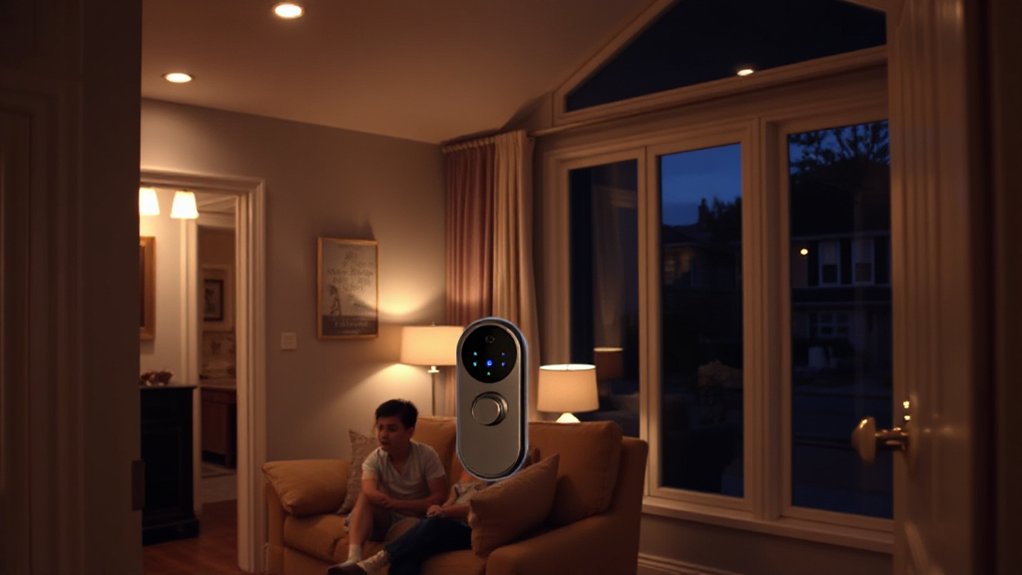
Integrated correctly, home automation systems transform security from a reactive set of locks and alarms into a proactive, sensor-driven protection layer that continually monitors the perimeter and interior of your home. You orchestrate Security cameras, alarm systems, smart locks, and motion detectors through a unified hub, so every component shares data and responds in real time.
You configure zones, schedules, and automation rules: doors auto-lock at night, exterior lights trigger on motion, and interior pathways illuminate when you arrive. High-resolution cameras stream to your phone, while AI-based analytics flag unusual behavior instead of every trivial movement.
When a sensor trips, integrated alarm systems notify you instantly, trigger sirens, and capture forensic video, giving you verifiable insight and genuine, design-led peace of mind.
Cutting Energy Use and Monthly Bills Automatically
Instead of relying on guesswork and static schedules, you use home automation to treat energy as a controllable design variable—measured, optimized, and adjusted in real time. Sensors, smart meters, and responsive devices coordinate to cut consumption without sacrificing comfort or aesthetics.
You define performance rules; the system enforces them continuously, guided by data, not habits.
Core tactics include:
- Adaptive HVAC that learns occupancy and thermal behavior.
- Smart lighting scenes tied to daylight levels and room usage.
- Utility monitoring dashboards that expose real-time costs and peak loads.
- Load shifting that times appliances around rate changes and Renewable energy output.
- Standby power control that cuts phantom loads on schedules or presence cues.
The result: lower bills, higher efficiency, and a more intentional home.
Getting Started: Simple Home Automation Upgrades
Once you understand what’s possible, getting started with home automation means targeting a few high‑impact, low‑complexity upgrades that immediately change how your space functions. Begin with smart bulbs and switches; they install in existing fixtures, let you define scenes, and give you precise dimming and scheduling without rewiring.
Next, deploy a smart thermostat to stabilize comfort bands and manage temperature based on occupancy patterns. Add connected plugs for lamps or small appliances you want to automate without replacing.
Centralize control through a hub or platform that supports robust device integration, so lights, climate, and plugs respond as a unified system. Layer in voice control via a smart speaker, enabling hands‑free commands that streamline everyday routines and reinforce intuitive, design‑clean interfaces.
Avoiding Common Home Automation Mistakes
Although home automation can radically enhance comfort and efficiency, many projects falter because they overlook planning, standards, and long‑term adaptability. You avoid costly redesigns when you treat your home like a cohesive system, not a collection of gadgets. Think in terms of architecture, interoperability, and lifecycle.
Focus on these critical areas:
- Choose devices that support open standards and local control, not closed, cloud‑locked ecosystems.
- Design your Wi‑Fi and network first; automation fails when connectivity’s weak or insecure.
- Harden configurations against security pitfalls: strong authentication, firmware updates, and segmented networks.
- Address privacy concerns by minimizing cloud data, using local processing, and auditing app permissions.
- Map use cases before buying hardware, then document scenes, naming conventions, and physical layouts.
Frequently Asked Questions
How Does Home Automation Impact Privacy Laws and Data Ownership Rights?
You expose personal telemetry, so home automation reshapes privacy laws and data ownership rights through Data security standards, granular consent, and enforceable Privacy policies, requiring you to negotiate vendor contracts, demand local processing, and architect data‑minimizing device ecosystems.
Can Smart Home Devices Meaningfully Assist People With Disabilities or Mobility Challenges?
Yes, you can gain substantial support: smart devices function as Assistive technology, enabling hands‑free control, environmental monitoring, and routine automation. These Accessibility improvements reduce physical strain, optimize spatial layouts, and integrate with mobility aids, enhancing independent, safe living.
What Are the Long‑Term Health Effects of Constant Connectivity and Automation at Home?
Constant connectivity may degrade sleep architecture, elevate baseline stress, and impair attention; you’ll need scheduled digital detox intervals, adaptive notification design, and ambient biophilic cues to protect cognitive load, circadian alignment, and long‑term mental well being in automated homes.
How Do I Evaluate the Total Cost of Ownership for a Home Automation Ecosystem?
You evaluate total cost of ownership by starting cost analysis with hardware, installation, and integration; then project 5–10 year maintenance costs—software updates, device replacements, energy use—considering that 30% of smart-home budgets typically go to ongoing upkeep.
What Happens to My Smart Home Setup if the Manufacturer Goes Out of Business?
Your devices may lose cloud services, updates, and integrations; you’ll often revert to local-only control. You prioritize manufacturer stability, open standards, local APIs, and strong data security practices to preserve functionality and protect stored credentials and usage histories.
Conclusion
In the end, you’re not just installing gadgets—you’re composing an ecosystem. Each sensor, scene, and schedule becomes a well‑tuned instrument in a responsive, architectural symphony. Lights dim like closing curtains, climate adjusts like a tailored suit, and security locks in like a precision‑engineered vault. When you design automation deliberately, your home stops behaving like a static structure and starts acting like a living framework, constantly optimizing for your comfort, time, safety, and efficiency.