
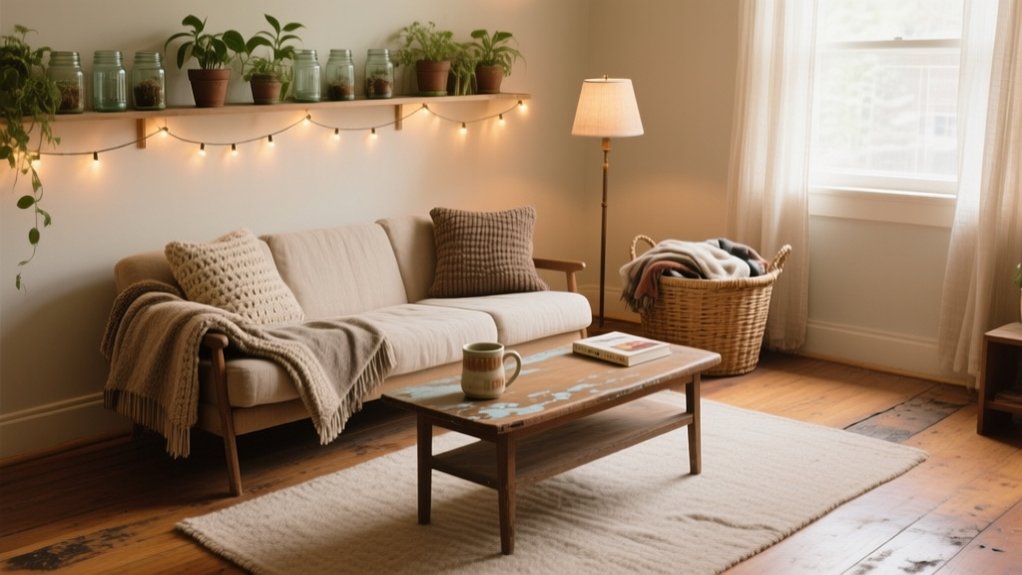

With furniture and decor costs up nearly 20% in recent years, creating a cosy living room on a budget demands a more strategic approach. You’ll need to prioritise space planning, layered lighting, and targeted updates that maximise impact per pound. By focusing on textiles, colour temperature, and multifunctional furniture, you can engineer comfort without overspend. The key is knowing which changes transform the atmosphere—and which are just costly distractions you can skip.
Key Takeaways
- Plan your layout and budget first, using compact furniture, clear walkways, and vertical storage to maximise space without unnecessary purchases.
- Warm up the room with affordable textiles: layered rugs, cosy throws, and removable cushion covers made from remnants or repurposed knitwear.
- Use warm lighting—table and floor lamps, plug-in sconces, and LED candles—with 2700K bulbs to create a soft, inviting glow.
- Refresh walls cheaply with warm neutral paint, a simple feature wall, and cohesive, DIY artwork using fabric or leftover paint.
- Thrift or upcycle solid wood and vintage pieces, sanding and painting them in matte warm tones for high-impact, low-cost upgrades.
Start With a Cosy Living Room Plan on a Budget

Before you buy a single cushion or paint sample, establish a clear, budget-conscious plan that defines how you’ll use the living room, what must stay, and what can go.
Begin with zoning: identify a primary seating area, secondary perch (like a reading chair), and circulation routes. List your furnishing essentials—sofa, task and ambient lighting, compact coffee table, and smart storage—then rank them by priority and cost.
Measure the room accurately and sketch a scaled layout to avoid purchasing oversized pieces.
Embrace modern minimalism: specify fewer, multi-functional items (e.g., storage ottoman, nesting tables) to reduce visual clutter and expense.
Set a firm total budget, then allocate percentages to furniture, textiles, and accessories, tracking every projected cost before you commit.
Use Colour and Paint to Warm Up Your Living Room
With your layout and budget parameters defined, you can now use colour and paint to generate warmth and cohesion without overspending. Start by establishing color schemes that favour warm neutrals—think taupe, greige, clay, and caramel—then layer one or two deeper accent hues like rust, terracotta, or forest green. This creates visual depth without constant redecorating.
Use paint techniques to enhance proportion and intimacy. Paint the ceiling a half-tone darker than the walls to lower the visual height and increase cosiness. Darken the skirting boards and internal doors to anchor the room.
If your budget’s tight, create a single feature wall behind the sofa using leftover paint or sample pots, applying a soft, feathered edge instead of masking for a relaxed, cocooning effect.
Cosy Living Room Lighting Ideas That Cost Very Little
You can transform the mood of your living room with warm, layered lighting that relies on a few low-cost adjustments rather than expensive fixtures.
By combining task lamps, accent lights, and soft ambient sources, you’ll create depth, eliminate harsh shadows, and make the space feel instantly more inviting.
Next, you’ll see how to use budget-friendly bulbs, plug-in lights, and simple positioning tricks to achieve a soothing, ambient glow.
Warm Layered Lighting Tricks
Although many people assume cosy lighting requires expensive fixtures, you can create a warm, layered glow in your living room using simple, low-cost strategies and a bit of planning.
Start by zoning the space: designate a reading corner, conversation area, and media zone, then assign each a dedicated light source.
Use warm white LED bulbs (around 2700K) in small table lamps to form your base layer.
Add mid-level illumination with adjustable floor lamps to eliminate harsh shadows and balance brightness.
Integrate string lights along shelves or curtain poles to introduce a soft, decorative shimmer without glare.
Finally, deploy flickering candles—real or LED—as your accent layer, concentrating them on coffee tables and mantels to create depth, warmth, and visual hierarchy.
Affordable Ambient Glow Ideas
One of the fastest ways to create an ambient glow on a tight budget is to repurpose light sources you already own and refine how they’re deployed. Reposition table lamps toward walls to bounce light and generate soft illumination without glare. Fit them with warm‑white LED bulbs (around 2700K) to simulate cosy evening light and reduce energy consumption.
Use string lights as low‑cost ambient lighting: drape them along curtain poles, bookshelves, or window frames to create a continuous, diffused glow. Clip‑on lamps attached to shelves can function as inexpensive uplighters when aimed at the ceiling.
If you’ve got harsh overheads, soften them with a translucent paper or fabric shade, ensuring safe clearance from the bulb, to instantly reduce visual harshness.
Budget Textiles That Instantly Make a Room Snug
When funds are tight, strategic use of budget textiles delivers the fastest comfort upgrade in a living room. Start with textile layering: combine a flat-weave rug with a soft fleece throw and structured cushions to create multi-depth softness under hand and foot. This stacked approach amplifies warmth without major expense.
Prioritise fabric textures that visually read as cosy. Choose chenille, brushed cotton, sherpa, and chunky knits over shiny synthetics; they diffuse light and signal warmth. Use cushion covers with removable zips so you can rotate looks seasonally while reusing inserts.
Add a budget runner or small rug to anchor “cold” zones like near a doorway. Finally, hang inexpensive, weighty curtains to reduce echo, insulate, and visually soften hard architectural lines.
Affordable Furniture Swaps and Layout Tricks
You can radically upgrade a living room’s comfort by targeting high-impact furniture swaps and simple layout optimizations instead of full replacements.
By sourcing structurally sound secondhand pieces and pairing them with a strategic floor plan, you’ll improve circulation, visual balance, and seating capacity on a tight budget.
Next, you’ll assess which items to replace, what to hunt for secondhand, and how to reconfigure your layout for maximum function and warmth.
Smart Secondhand Furniture Finds
Few strategies stretch a small budget further than sourcing secondhand furniture and rethinking your layout with intention. You’ll maximise impact by targeting high-visibility, high-contact pieces first: the sofa, coffee table, and storage.
Prioritise structural integrity over superficial wear. Test frame stability, spring tension, and cushion density; surface scratches are easily fixed with sanding, stain, or paint. Focus on secondhand gems in solid wood, real leather, or metal rather than chipboard or peeling veneer.
When hunting for vintage treasures, measure meticulously and keep room dimensions and door widths on your phone. Bring fabric swatches to ensure tonal harmony with existing textiles.
Negotiate assertively using evidence of wear, and factor in minor refurbishment costs. With careful curation, your “new” room reads cohesive, not cobbled together.
Space-Saving Layout Tweaks
Even in a compact living room, strategic layout tweaks and a few targeted furniture swaps can release surprising amounts of usable space. Start by editing your furniture arrangement: float the sofa slightly off the wall, align it parallel to the room’s longest dimension, and eliminate bulky side tables in favour of slim nesting tables.
Prioritise dual-purpose storage solutions. Swap a traditional coffee table for an ottoman with internal storage, and choose a media unit with closed cabinetry to reduce visual clutter. Mount shelves vertically to exploit wall height and free floor area.
Use armless accent chairs or a compact loveseat instead of oversized seating. Position lighting on walls or floor lamps behind furniture to preserve circulation paths and maintain an open, cohesive layout.
Cheap Décor Accents That Add Personality and Charm
Although a tight budget can seem restrictive, small, inexpensive décor accents can recalibrate your living room’s entire atmosphere and visual hierarchy. Start by layering textiles: add a tightly edited combination of cushions and a throw with distinct textures—bouclé, linen, or chenille—to create depth without visual clutter.
Integrate Vintage accents, such as a small brass clock, ceramic figurine, or framed postcard, to introduce patina and narrative. Position them in clusters on a side table or shelving unit to form curated vignettes.
Use Metallic touches strategically—brushed brass candleholders, a chrome tray, or copper picture frames—to reflect light and enhance perceived brightness.
Finally, deploy inexpensive greenery in cohesive planters to soften hard lines and create a more intimate, human-scaled environment.
DIY Projects for a Cosy Living Room Makeover
When you leverage simple DIY projects, you can radically upgrade your living room’s comfort and aesthetics without inflating costs. Focus on tactile materials, layered lighting, and re-engineered surfaces that visually warm the space.
1. Revive pieces with furniture painting
Sand, prime, and paint dated tables or TV units in warm neutrals. A matte topcoat reduces glare and looks higher-end.
2. Construct a custom blanket ladder
Use basic timber, screws, and stain to create vertical storage for throws, adding height and softness.
3. Create textile-based DIY crafts
Sew simple cushion covers from upholstery remnants or reuse old knitwear for textured pillow fronts.
4. Design framed fabric or wallpaper panels
Stretch fabric over canvas or MDF, staple, and hang as large-scale art to inject pattern and colour economically.
Small Living Room Ideas for Maximum Cosiness
Because every square metre has to work harder in a compact space, a small living room benefits most from intentional zoning, scaled furniture, and layered sensory comfort. Start by defining a primary seating zone with a compact sofa, armless accent chair, and a narrow coffee table; keep walkways at least 60 cm wide.
Use vertical storage and slimline shelving to free floor area.
Mount your TV above fireplace mantels or on a wall bracket to eliminate bulky media units. Deploy wall art in a cohesive colour palette to create a visual focal point without consuming space.
Add texture through a dense rug, tactile cushions, and a throw, then use warm, low-level lighting—table lamps, floor lamps, and plug-in sconces—to enhance perceived cosiness.
Seasonal Cosy Living Room Updates on a Budget

You’ve optimised your layout and furniture, so now you can make your living room feel seasonally fresh and cosy without overspending. Focus on small, high‑impact interventions you can rotate through the year.
1. Update textiles
Swap in seasonal cushions and lightweight throws in summer, then heavier knits and velvets in winter. Use removable covers to minimise cost and storage.
2. Restyle fireplace mantels
Treat your mantel as a rotating vignette: candles and pine in winter, foliage and ceramics in spring, shells or glass in summer, warm metallics in autumn.
3. Layer lighting
Add inexpensive plug‑in wall lights, fairy lights, or warm‑white LED candles for adaptable ambience.
4. Introduce seasonal scent and greenery
Use budget‑friendly candles, diffusers, and supermarket greenery to signal each season without visual clutter.
Frequently Asked Questions
How Can I Make a Rented Living Room Cosy Without Losing My Deposit?
You prioritise reversible changes: add removable wall art, layered textiles, and freestanding lamps; deploy DIY decor like slipcovers, washi-tape frames, and tension-rod curtains. Avoid drilling; use command strips and furniture placement to reconfigure ambience without jeopardising your deposit.
What Are the Best Budget-Friendly Cosy Upgrades That Are Also Pet-Friendly?
You think everything cosy costs extra, but you’ll optimise Budget friendly decor with washable slipcovers, dense foam dog-beds, layered Pet safe textiles, low-pile rugs, wall-mounted shelves, cord protectors, and wipeable throws that resist dander, claws, and accidental spills.
How Do I Keep a Cosy Living Room Cool and Comfortable in Summer?
You keep a cosy living room cool by maximizing air circulation with cross‑ventilation, oscillating fans, and open pathways, then layering cooling accessories like breathable cotton throws, reflective blinds, light rugs, and LED lighting to minimize heat load.
Can I Create a Cosy Living Room That’s Also Child-Safe and Clutter-Free?
Yes, you can. Prioritize rounded furniture, anchored bookcases, outlet covers, and cordless blinds for safety. Apply clutter organization ideas: labeled bins, wall-mounted storage, and hidden-compartment ottomans. Use these child proofing tips systematically to maintain cosy, streamlined functionality.
How Much Should I Realistically Budget for a Full Cosy Room Refresh?
You should allocate 5–10% of your room’s value, prioritizing modular furniture arrangements and layered lighting enhancements. You’ll notice, almost by coincidence, how small investments in textiles, dimmers, and storage dramatically optimize comfort, safety, and long‑term functionality.
Conclusion
You’ve seen how to plan strategically, how to layer colour and light, how to deploy textiles, furniture, and décor for maximum impact at minimal cost. Now it’s your turn to measure precisely, rearrange intelligently, and upgrade selectively. Prioritise comfort, optimise circulation, and standardise simple DIY tweaks. When you iterate seasonally—swapping covers, adjusting lamps, rotating accessories—you don’t just save money; you systematically engineer a cosy living room that works hard every day.