


Introduce Art Nouveau elements subtly by choosing one focal piece, such as an opaline glass pendant or a Glasgow School-inspired print, then keep everything else calm. Add just one or two “whiplash” curves in hardware or edging, and stick to a tight palette: a neutral base with sage, peacock, or inky blue plus smoked brass. Use small-scale botanical motifs twice only, and layer matte, satin, and gloss finishes. Carry on for practical lighting, textiles, and taps.
Key Takeaways
- Add one or two “whiplash” curves in trims, mirrors, or hardware, keeping surrounding lines simple and restrained.
- Limit colors to a neutral base plus one muted accent and one metal, matching undertones for a cohesive, modern feel.
- Choose one focal Art Nouveau piece—poster, stained glass, or sculptural light—and give it a prominent, uncluttered placement.
- Use authentic materials and finishes like brass, oak, and opaline glass, favoring refined craftsmanship over decorative excess.
- Repeat small motifs sparingly across two touchpoints—like a lampshade and cushion—using subtle patterns and varied textures for depth.
3 Rules for Subtle Art Nouveau Style

Although Art Nouveau is known for its dramatic curves and ornate detail, you can keep it subtle by applying three simple rules. First, control the line: introduce one or two sinuous “whiplash” curves in trims, ironmongery, or edging, and keep the rest of the geometry calm. Second, restrain the palette: use British-appropriate, slightly muted tones—sage, peacock, cream, and smoked brass—so the pattern reads as refinement, not theatre. Third, respect context: let Historical influences guide you by referencing local makers and period proportions, then use Cultural adaptations to suit modern UK living—cleaner finishes, fewer motifs, and practical materials that meet today’s durability expectations. Follow these rules and you’ll achieve a nod to Art Nouveau without turning a flat into a pastiche.
Pick One Art Nouveau Focal Piece
Once you’ve kept the curves, colours, and context under control, choose a single Art Nouveau focal piece to carry the theme so the rest of the room can stay calm. Make it deliberate: a period poster, a stained-glass panel, or a sculptural light fitting inspired by Glasgow School motifs. Position it where sightlines naturally land—over the mantel, at the end of a hallway, or centred above a sideboard—and give it breathing space with plain walls and restrained accessories. Check scale against typical UK rooms; in a Victorian terrace, one oversized piece can overwhelm. Prioritise craftsmanship and materials—brass, oak, opaline glass—so it reads authentic, not themed. Look for Abstract geometry and Cultural influences in pattern and iconography.
Use Art Nouveau Curves in Key Silhouettes
Start by shaping your silhouette with Art Nouveau curves where they read first: the neckline and the lapels. Choose softly rounded necklines and sweeping lapel lines that echo the era’s whiplash motif without compromising fit. Then carry that fluidity through with flowing hemlines and controlled drapes that move cleanly as you walk.
Curved Necklines And Lapels
Where can you introduce Art Nouveau’s signature flow without overhauling your entire look? Start at the collar area, where a small curve reads intentional. For neckline styling, choose a soft scoop, shallow sweetheart, or gently notched boat that echoes a whiplash line without looking costume. Keep proportions controlled: the curve should frame your collarbones, not drop too low for daywear. In tailoring, prioritise lapel detailing. A rounded peak, softened notch, or subtly rolled shawl lapel brings that botanical sinuosity to blazers and coats. Ask your local alterations service to re-shape a lapel edge or adjust a collar stand; it’s affordable and precise. Stick to wool crepe, gabardine, or silk satin so curves hold their line cleanly.
Flowing Hemlines And Drapes
How do you bring Art Nouveau’s whiplash curve into your outfit without leaning on obvious prints? Focus on movement. Choose flowing hemlines that sweep rather than cling: a bias-cut midi skirt, an asymmetric wrap dress, or wide-leg trousers that break softly over your shoes. You’re aiming for an S-line in motion, not a costume silhouette.
Use draped fabrics to echo the same line through the torso. Look for cowl necks, gentle gathers at one hip, or a cape-like overlay on a coat. Keep the palette restrained—ink, oat, bottle green—so the curve reads as tailoring. Finish with pointed-toe boots or slim Mary Janes, and let the hem do the talking in the British weather.
Keep It Modern With a Tight Color Palette
Two or three carefully chosen hues will keep your Art Nouveau touches feeling crisp and contemporary, rather than overly ornate. Start with a neutral base—chalky white, warm grey, or inky navy—then add one accent and one metallic. In UK homes, muted sage with brass, or aubergine with nickel, reads refined without shouting.
Prioritise Color harmony by matching undertones: keep everything warm, or keep everything cool. Limit contrast to one focal point, such as a painted door surround or a single upholstered chair. Hold to Pattern simplicity by repeating the same tone across trims, lampshades, and soft furnishings, rather than mixing multiple prints. If you want depth, vary finish not colour: matt walls, satin woodwork, and a touch of gloss on hardware.
Add Small Botanical Motifs (No Overload)
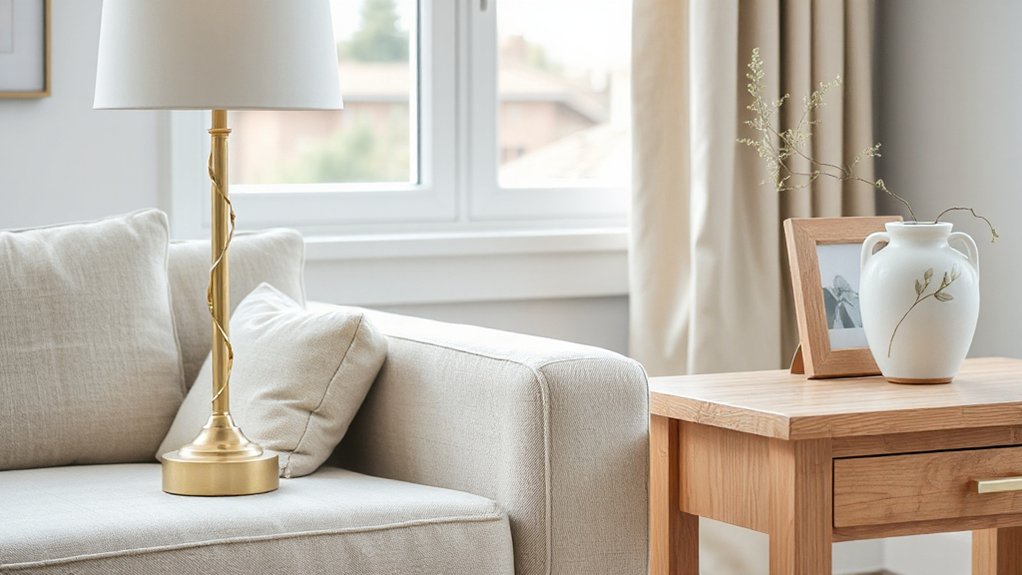
Once you’ve kept your palette tight, add Art Nouveau character with petite floral accents placed sparingly on corners, borders, or key junctions. Use leafy linework details in fine strokes to guide the eye without competing with your main forms. Finish with subtle vine pattern touches—think a restrained repeat at a margin or panel—so the room reads refined, not overworked.
Petite Floral Accents
Where should you place Art Nouveau florals so they feel intentional rather than fussy? Start with one small zone per room and keep the scale petite: a single cushion piped with a Vintage botanical sprig, a set of coasters with Organic motifs, or a bud vase with one stem on a sideboard. Choose muted, inky tones—sage, peacock, tobacco—so the detail reads refined in typical UK light. Repeat the accent twice, max, to create rhythm without clutter: match a motif on a lampshade trim to a picture mount, or echo it on a ceramic knob. Prefer quality over quantity; one well-made embroidered detail beats scattered prints. Keep backgrounds plain and finishes calm.
Leafy Linework Details
After you’ve nailed petite floral accents, introduce Art Nouveau’s leafy linework to sharpen the look without adding fuss. Keep lines slender, flowing, and clearly legible, as if inked with a fine nib. Use small botanical motifs—single leaves, paired fronds, or a modest sprig—placed where the eye naturally pauses: a mirror corner, a lampshade seam, a cabinet pull plate.
Limit yourself to one repeat per surface, then stop. You’ll get the era’s rhythm without clutter. Choose muted brass, smoked glass, or deep green enamel for definition, and echo the curve once in your joinery or metalwork. If you’re framing artwork, add decorative borders in pencil-thin strokes. Treat ornamental motifs as punctuation, not wallpaper.
Subtle Vine Pattern Touches
If you want a clearer Art Nouveau nod without turning the room into pattern-on-pattern, introduce vine motifs in short, controlled runs. Use a slim border on a stair runner, a single cushion panel, or a lampshade trim, keeping the scale tight and the linework clean.
Choose one finish and repeat it sparingly: etched glass in a cabinet door, a vine pattern on a single wallpaper drop behind a console, or laser-cut metal on a radiator cover. Keep colours muted—sage, ink, warm ivory—so the motif reads as detail, not wallpaper takeover. Limit your botanical motifs to two plant types (for example, ivy and wisteria) and avoid mixed florals. In UK terraces, this keeps period character intact while adding quiet movement.
Materials That Feel Art Nouveau (Subtly)
Although Art Nouveau is often associated with sweeping whiplash curves and ornate detailing, you can evoke it quietly through material choice alone. Start with Materials selection that nods to the period: walnut or oak with a warm, fumed stain; honed marble with soft veining; and ceramic tiles in muted sage, cream, or peacock blue. Choose metals with restraint—aged brass, bronzed iron, or patinated copper—used in small trims and hardware rather than showy statements. For Texture enhancement, layer tactile finishes: ribbed reeded glass, lightly etched mirrors, and mohair or velvet upholstery in matte, dusty tones. In UK homes, pair these with plaster walls, linen curtains, and encaustic-style flooring to suggest craftsmanship without tipping into pastiche. Keep joins clean and proportions calm.
Modern Art Nouveau Lighting Ideas
While you don’t need stained-glass swans and curling tendrils to get the Art Nouveau mood, the right lighting will do most of the heavy lifting in a modern UK room. Choose opal or acid-etched glass pendants with softened profiles; they echo period lamps without looking themed.
Pick a slim floor lamp with a gently arched stem to suggest botanical lines, then keep the base understated in satin brass or blackened steel. Add Decorative motifs through subtle perforations, reeded shades, or leaf-like silhouettes, not literal florals. For Color contrasts, pair warm 2700K LEDs with cooler wall colours—sage, ink blue, or putty—so the glow reads creamy and intentional. In Victorian terraces, use shallow ceiling roses and compact semi-flush fittings to suit lower heights. Fit dimmers throughout to control ambience precisely.
Art Nouveau Hardware: Pulls, Taps, Hinges
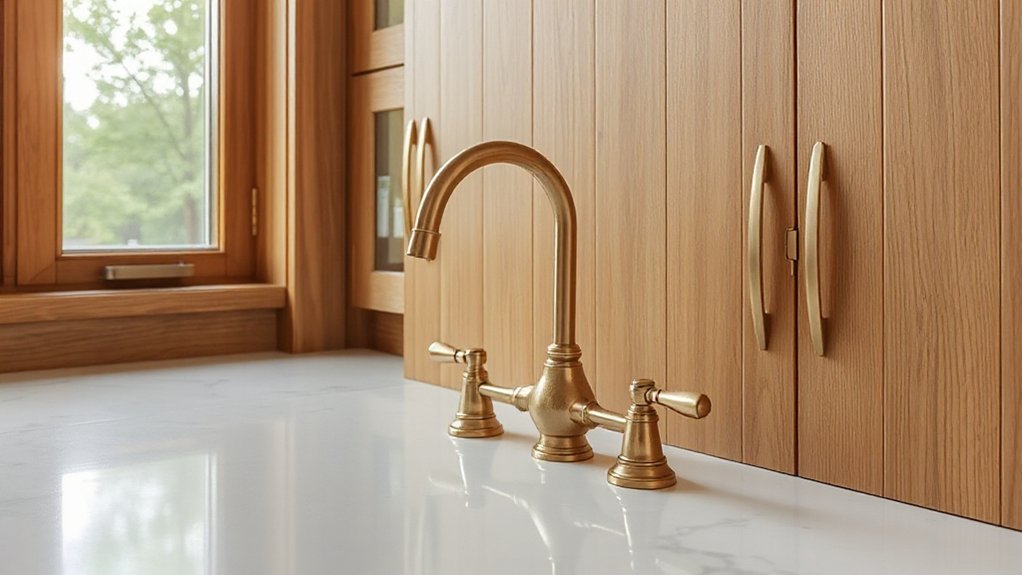
You’ll sharpen the Art Nouveau feel with hardware that treats every touchpoint as part of the design, starting with curvilinear cabinet pulls that echo the era’s flowing linework. Specify botanical taps with sinuous stems and leaf-like levers, and you’ll bring that organic motif into everyday use without overstatement. Finish with matching hinges—subtle, sculpted, and properly aligned—so doors and drawers read as a cohesive, period-aware scheme.
Curvilinear Cabinet Pulls
In Art Nouveau interiors, curvilinear cabinet pulls bring the style’s signature flow into daily use, turning a simple grip into a sculptural detail. You’ll get the most subtle effect by swapping hardware first, rather than changing doors or fronts, especially on Vintage furniture where you want to preserve patina and proportions.
Choose pulls with elongated S-curves, softened edges, and a gentle thumb rest; they feel modern yet period-aware. In UK homes, consider unlacquered brass for warm ageing, satin nickel for cooler schemes, or dark bronze to ground painted cabinetry. Keep sizes consistent across a run, and match the fixing centres to existing holes to avoid filler marks. Treat them as decorative accents: repeat the curve on just one dresser or sideboard, then stop.
Botanical Taps And Hinges
Two small hardware swaps—botanical taps and leaf‑worked hinges—can push an Art Nouveau scheme from “inspired by” to convincingly period. Choose taps with sculpted stems, bud-shaped levers, or lily spouts, and keep the silhouette sinuous rather than blocky. In UK bathrooms and sculleries, aged brass, nickel plate, or unlacquered copper reads authentic and wears in gracefully. Treat hinges as jewellery: you’ll notice them every time you open a cupboard. Look for pierced knuckles, tendril tips, and light ornamental embellishments that echo your tiles or stained glass without shouting. Aim for consistency across rooms, but vary scale so it doesn’t feel themed.
- Match finishes to existing ironmongery for cohesion
- Repeat decorative motifs, not identical patterns
- Prioritise smooth action and solid fixings over novelty
Textiles and Wallpaper: Light Nouveau Pattern
Although Art Nouveau is often associated with bold, whiplash curves and jewel-like colour, a lighter pattern can feel more British in a lived-in home, especially across textiles and wallpaper. Choose wallpaper patterns with stylised stems, ginkgo fans, or soft peacock feathers, but keep the scale small and the palette misty: sage, stone, warm ivory, and inky blue. In north-facing rooms, favour matte grounds to avoid glare; in bright bays, you can take a slight sheen. Layer Textile textures through linen curtains, wool throws, and velvet cushions with tone-on-tone embroidery, so the motif reads as craft rather than costume. Repeat one curve in two places only—say, a blind trim and a cushion—then let plain paint and oak joinery calm it down.
Art Nouveau Art and Mirrors for Fast Impact
If you want Art Nouveau character without redecorating, hang one strong period print and introduce a curving mirror to bounce light and soften the room’s hard lines. Choose a poster-style lithograph or a botanical study with whiplash lines; keep the mount simple and the frame slim in ebonised wood or antique brass. Place the mirror opposite a window to pull daylight deeper into a typical UK terrace room and to echo those flowing curves.
- Pick artwork with restrained colours and decisive linework, not busy pastiche.
- Use an asymmetrical mirror top or etched border to nod to Art Nouveau fashion.
- Add a small tray for Art Nouveau jewelry so metalwork details repeat quietly.
Limit yourself to one hero print and one mirror per room.
Frequently Asked Questions
How Do I Mix Art Nouveau With Scandinavian or Japandi Interiors?
You mix Art Nouveau with Scandinavian or Japandi by keeping a calm palette, then layering controlled ornamental patterns and floral motifs via wallpapers, rugs, and lighting. Choose slimline oak, curved brass, and UK-made ceramics; avoid clutter.
What Are Budget-Friendly Ways to Add Art Nouveau Without Renovations?
Like adding a ribbon of vine to a plain wall, you’ll get Art nouveau motifs cheaply with peel-and-stick wallpaper panels, charity-shop mirrors, stained-glass-style film, and curvy lamps. Keep it refined with Subtle decorative accents, UK retailers.
Where Can I Find Authentic Vintage Art Nouveau Pieces Safely Online?
You’ll find authentic vintage Art Nouveau safely on UK sites like 1stDibs, Vinterior, and eBay’s Authenticity Guarantee, plus vetted Artisan marketplaces; verify provenance, request condition reports, use escrow/PayPal, and cross-check sellers at Antique fairs.
Which Art Nouveau Elements Should Renters Avoid Altering Permanently?
You’ll want to steer clear of anything that leaves a lasting whisper: stripping original woodwork, repainting Victorian details, drilling for stained glass, swapping period tiles, or fixing Gothic motifs into plaster. Use removable hooks, decals, and freestanding screens instead.
How Do I Keep Art Nouveau Touches From Looking Kitschy or Theme-Like?
You keep Art Nouveau touches from looking kitschy by limiting ornamental motifs to one or two focal pieces, choosing muted floral patterns, and balancing with plain British modern basics—neutral walls, simple textiles, and restrained brass accents.
Conclusion
You don’t need to overhaul your home to get Art Nouveau right; you just need restraint. Start with one standout piece, echo it with a few sinuous curves, and keep your palette tight so it reads modern, not themed. Add botanical motifs sparingly in lighting, hardware, or a single textile. Interesting stat: the V&A holds over 2.8 million objects, proving how powerful small, well-chosen details can be. Apply that mindset and you’ll nail it.