
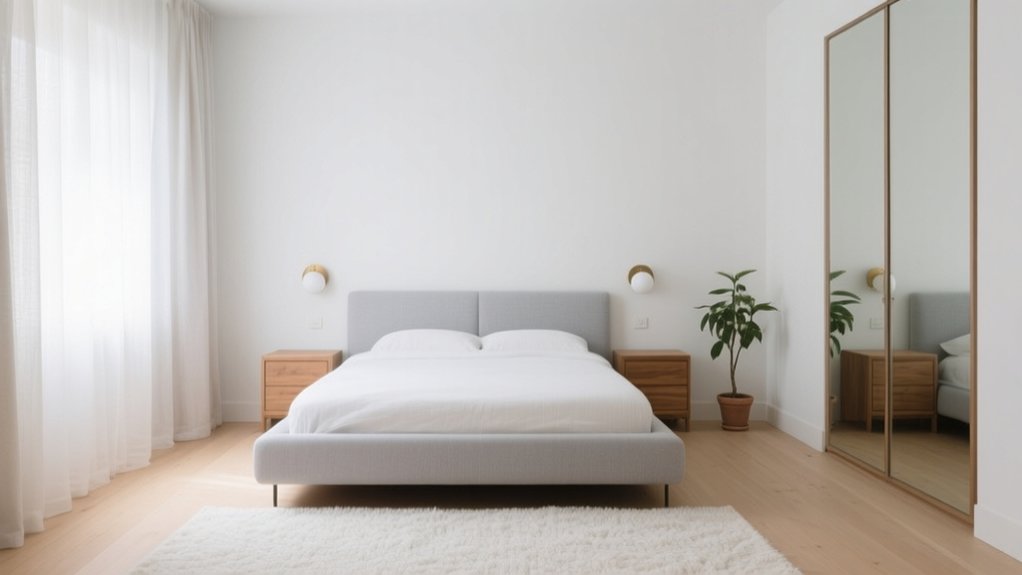

When you’re working with a compact master bedroom, every inch must perform. You can’t rely on bulky casegoods or arbitrary décor; you need strategic furniture placement, integrated storage, and a restrained materials palette to control visual clutter and circulation. By treating your room like a well-planned micro-suite—where the bed, wardrobe, and accent pieces serve multiple functions—you can create a space that feels intentional, serene, and far more generous than its footprint suggests…
Key Takeaways
- Center a low-profile bed on the shortest wall, using slim wall-mounted nightstands to free floor space and keep circulation clear.
- Maximize vertical storage with full-height wardrobes, overhead cabinets, and under-bed drawers to reduce clutter and replace bulky dressers.
- Use a light, low-contrast color palette and layered, dimmable lighting to make the room feel brighter, larger, and more relaxing.
- Choose multifunctional furniture, like lift-up beds, storage benches, and compact desks under windows, to combine work, storage, and seating.
- Keep decor minimal and cohesive—one statement artwork, streamlined textiles, and limited accessories—to maintain a clean, luxurious, cocooning feel.
Maximize Layout: Smart Furniture Placement in Small Bedrooms
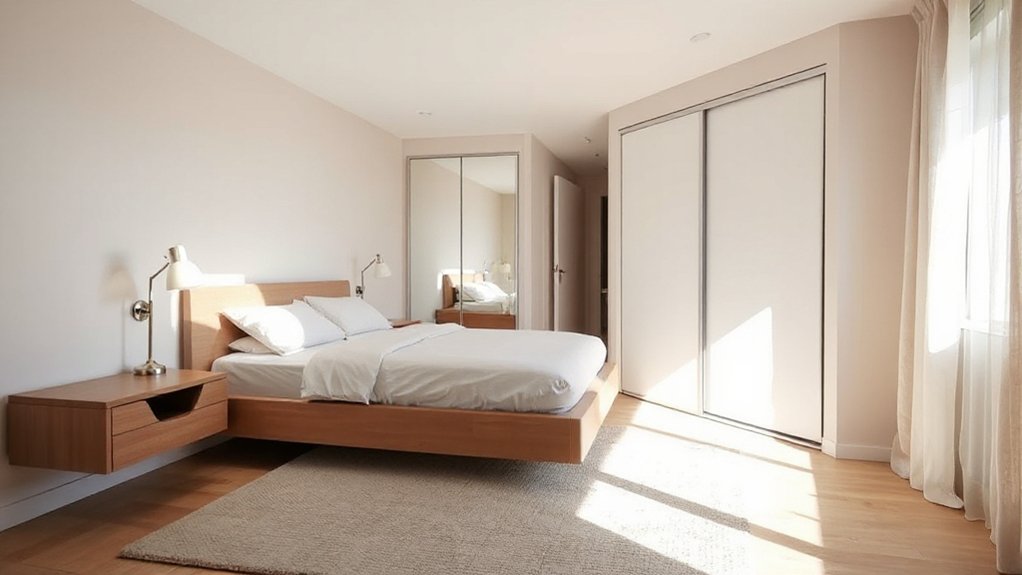
When square footage is limited, strategic furniture placement becomes the primary tool for transforming a cramped master bedroom into a functional, visually balanced retreat. You start by defining a clear focal wall for the bed, then align nightstands symmetrically to reinforce visual order and support bedroom feng shui principles.
Position storage pieces along the longest uninterrupted wall to preserve circulation paths and prevent visual congestion. Maintain at least 30 inches of clearance around key zones so you can move easily without obstructions.
Choose minimal decor and tightly edited furniture: one bed, two streamlined nightstands, and a single multifunctional dresser or console. Keep pieces lifted on legs to expose more floor plane, which makes the envelope feel wider, cleaner, and more spatially coherent.
Space-Saving Master Bed Ideas for Tiny Rooms
Smart furniture placement sets the framework, but the bed’s footprint ultimately dictates how efficiently a tiny master bedroom performs. You’ll want to treat the bed as architectural infrastructure, not just décor.
Start by evaluating scaled-down bed frame options: low-profile platforms, slim metal frames, and wall-mounted headboards that reclaim visual space and circulation.
Choose mattress types that minimize bulk while preserving ergonomics—hybrid or high-density foam models often provide full support with less thickness. Consider a queen-short or full-XL if your layout can’t accommodate a standard queen.
Floating night ledges or integrated side rails replace bulky bedside tables, preserving negative space. Prioritize frames with clean lines and light-clearance underneath to keep the room feeling airier, more spacious, and visually coherent.
Storage Solutions That Keep Your Small Master Clutter-Free
To keep a compact primary suite visually calm and highly functional, you must treat storage as an integrated design system rather than an afterthought. You’ll maximize every cubic inch by specifying clever under-bed storage, selecting multi-functional furniture with concealed compartments, and engineering vertical wardrobe organization that exploits full ceiling height.
Clever Under-Bed Storage
Consider these strategic options:
- Integrated drawers with full-extension glides, ideal for folded garments and spare linens.
- Lift-up platforms with gas struts, creating hidden compartments for off-season textiles or infrequently used items.
- Modular rolling bins sized precisely to your bed’s footprint, labeled for quick visual inventory.
- Custom-built toe-kick drawers that align with the bed’s base, preserving a clean, monolithic look.
Specify consistent materials and front panels so storage reads as part of the bed’s architecture, not visual clutter.
And always allow adequate clearance for effortless access.
Multi-Functional Furniture Pieces
When every square foot has to earn its keep, multi-functional furniture lets your master bedroom operate like a well-organized studio rather than a cramped afterthought. You should prioritize pieces with integrated, hidden storage that visually declutter the room while maximizing capacity. Specify a bed with hydraulic lift or gas-spring mechanisms so linens and off-season clothing disappear beneath a seamless frame.
In tight footprints, convertible furniture becomes essential. A nightstand with divided drawers and cable-management channels doubles as a charging station. A storage bench with a hinged lid at the foot of the bed functions as both seating and linen trunk.
Consider a wall-mounted console that transforms from vanity to compact desk, ensuring every element performs at least two discreet, storage-forward tasks.
Vertical Wardrobe Organization
Why sacrifice precious floor area to bulky dressers when your master bedroom’s walls can shoulder the load? Prioritize vertical storage to reclaim circulation space and visually elongate the room. By elevating your wardrobe system, you’ll consolidate clothing, accessories, and linens into a single streamlined envelope, dramatically boosting wardrobe efficiency.
- Install full-height wardrobes with floor-to-ceiling doors to minimize visual clutter and maximize cubic capacity.
- Use double-hang rods, pull-down racks, and staggered shelving to exploit every vertical inch.
- Integrate slim overhead cabinets for off-season items, preserving prime zones for daily garments.
- Add vertical dividers, pull-out trays, and door-mounted organizers to segment categories and optimize retrieval.
Specify cohesive finishes and integrated lighting to create a tailored, architectural storage wall.
Color, Lighting, and Decor Tricks to Make Small Rooms Feel Bigger
To visually expand a compact master bedroom, you’ll want to manipulate color and light with intention.
Start by specifying a light, low-contrast color palette that reflects maximum luminance and minimizes visual breaks between walls, ceiling, and trim.
Then implement strategic layered lighting—ambient, task, and accent—to eliminate dark corners, flatten harsh shadows, and create an even, spacious glow.
Light Color Palettes
A calibrated light color palette immediately changes the perceived volume of a master bedroom, especially in compact spaces. When you deploy Pastel palettes and Neutral tones strategically, surfaces recede visually and boundaries blur, so the room feels broader and taller.
Use low-saturation hues with high Light Reflectance Values (LRV) on large planes—walls, ceiling, wardrobe fronts—to maximize bounce and minimize visual noise. Then introduce micro-contrasts to avoid a flat, clinical effect:
- Soft white or greige walls paired with slightly deeper trim for subtle depth
- A pale, cool-toned floor finish to elongate sightlines across the room
- Textiles in layered ivories, blush, or mist blue to keep the palette cohesive
- Minimal, color-coordinated artwork so vertical surfaces stay visually quiet
Strategic Layered Lighting
One of the most effective ways to visually expand a small master bedroom is to engineer a layered lighting scheme that mimics natural daylight. Start with a uniform, dimmable ceiling fixture that delivers an ambient glow and eliminates harsh shadows at corners, which visually compress space.
Next, integrate task illumination at the bed, vanity, and closet: wall-mounted sconces, directional reading lights, or LED strips under shelves keep surfaces bright without occupying floor area.
Finally, deploy accent lighting to articulate depth—backlit headboards, cove lighting, or picture lights draw the eye outward, stretching perceived dimensions. Use warm, consistent color temperatures (2700–3000K) and high CRI bulbs to maintain cohesion, while separate circuits and layered dimmers let you fine-tune mood and spatial emphasis.
Multifunctional Furniture for Compact Master Bedrooms
When floor area is at a premium, multifunctional furniture transforms a compact master bedroom into a high‑performance space without visual clutter. You prioritize pieces that integrate storage, conceal bulk, and maintain clean sightlines, so the room reads as ordered, not overfilled.
Select furniture with streamlined profiles and consistent finishes to preserve visual cohesion while still accommodating daily routines and discreet decorative accents and personal touches.
- Opt for a storage bed with lift-up hydraulics to house linens, out-of-season clothing, and luggage.
- Specify nightstands with integrated drawers, power outlets, and cable management.
- Use a wall-mounted desk that folds into a cabinet, doubling as a vanity.
- Incorporate an upholstered storage bench at the foot of the bed for seating and concealed organization.
Styling a Cozy, Luxury-Looking Master in a Small Space
Even in a compact footprint, you can orchestrate a master bedroom that reads as both cocooning and high-end by controlling proportion, texture, and visual hierarchy with intention. Start with a restrained palette, then layer luxury textiles—high thread-count sheets, a plush duvet, and a dense wool or silk rug—to create depth without clutter.
Specify a tailored headboard with vertical channeling or tufting to draw the eye upward, visually enlarging the envelope. Use warm, dimmable lighting with sconces or pendants to free surfaces and distribute a soft glow.
Curate statement accessories with discipline: an oversized art piece, sculptural bedside lamps, or a single metallic tray. Limit décor groupings to tight, edited vignettes so every element feels deliberate and quietly opulent.
Real-Life Small Master Bedroom Layout Ideas to Copy
After you’ve refined the palette, textiles, and lighting, the next step is configuring a floor plan that actually supports how you live in a compact master. Think in zones: sleep, storage, and circulation. You’re aiming for clear sightlines, minimal visual noise, and high-function surfaces.
Use these real-life layouts as plug-and-play templates:
- Float the bed centered on the shortest wall; anchor with artistic headboards and slim wall-mounted nightstands.
- Tuck a shallow dresser opposite the bed; mount the TV above to consolidate functions.
- Place a compact desk under the window; frame it with statement curtains that visually elongate the wall.
- In ultra-tight rooms, push the bed into a corner and integrate custom, full-height wardrobe cabinetry along one wall.
Frequently Asked Questions
How Can I Soundproof a Small Master Bedroom for Better Sleep?
You optimize sleep by combining soundproofing techniques: install solid-core doors, seal gaps with acoustic caulk, add dense rugs, and layer curtains with blackout liners. Integrate acoustic treatments—fabric wall panels, upholstered headboard, and ceiling baffles—to absorb reflections and reduce noise.
What Are Budget-Friendly Ways to Update a Small Master Bedroom?
You refresh it cheaply by recalibrating color schemes, upgrading textiles, and optimizing vertical storage solutions. Prioritize cohesive bedding, paint, and lighting. Integrate multifunctional furniture, conceal clutter, and exploit mirrors—don’t you deserve a visually expanded, ergonomic, boutique-grade retreat?
How Do I Choose the Best Mattress Size for a Small Master?
Choose the smallest mattress size that preserves circulation clearances on all sides. Evaluate Mattress types by thickness and edge support, then coordinate compact Bed frame styles—platform, storage, or low-profile—to maintain ergonomic access, visual balance, and ideal floor area.
What Is the Ideal Temperature for a Cozy Small Bedroom?
Aim for 60–67°F (15–19°C) to optimize sleep quality and thermal comfort. Then calibrate Decorating lighting and color schemes—use warm, dimmable lamps and desaturated, cool-toned palettes—to visually reinforce coziness while preventing perceptual crowding in your compact bedroom.
How Can I Incorporate Plants Without Overcrowding a Small Master Bedroom?
Use vertical solutions: mount shelves, install ceiling hooks, or add a narrow plant ledge. Prioritize space saving plants and low-maintenance indoor greenery. Cluster in odd numbers, maintain visual negative space, and avoid placing plants on primary circulation pathways.
Conclusion
You might think a small master limits your options, but constraints actually sharpen your design decisions. When you edit the layout, prioritize negative space, and specify multifunctional, built-in pieces, you create a room that’s both efficient and luxurious. Lean into a restrained palette, layered lighting, and integrated storage to reduce visual noise. You’re not just decorating a tiny bedroom—you’re engineering a calm, high-performance retreat that feels intentional, tailored, and quietly expansive.