
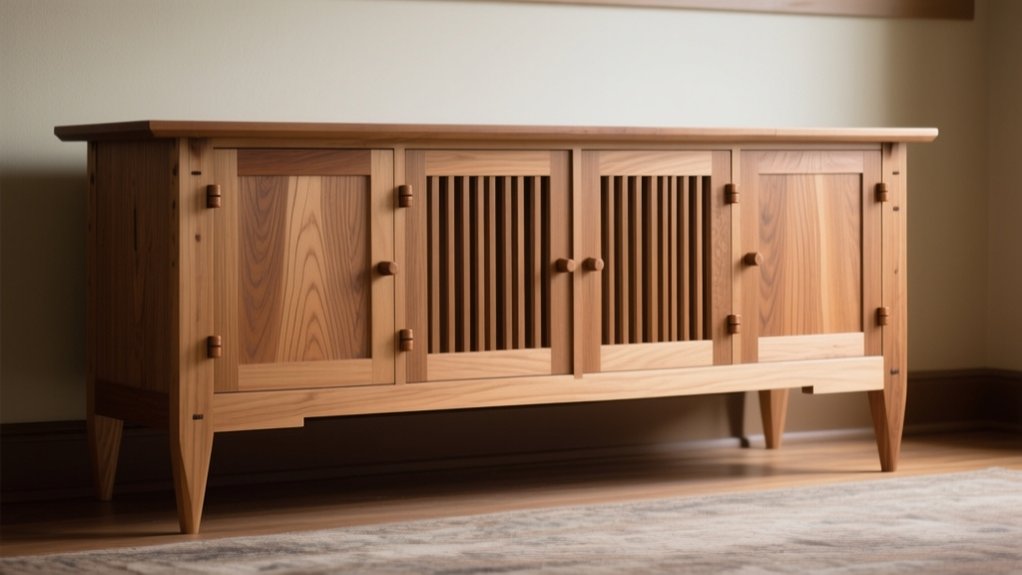

Mission style furniture gives you timeless, no-nonsense workmanship rooted in Arts & Crafts ideals: honest materials, purpose-led form, and repairable build quality. You’ll spot it in straight, disciplined geometry, weighty proportions, and vertical slats, often in quarter-sawn oak with visible ray fleck. Look for real joinery—pegged mortise-and-tenon, through-tenons, and slats housed in grooves—not staples or showy trim. Keep going and you’ll pick up maker cues and authenticity checks.
Key Takeaways
- Mission style emphasizes function-first design, honest materials, and disciplined geometry over ornate decoration.
- Rooted in the Arts & Crafts movement, it highlights craftsmanship, durability, repairability, and responsible, long-lasting construction.
- Signature details include straight lines, sturdy proportions, vertical slats, broad stiles and rails, and minimal ornamentation.
- Authentic pieces often use quarter-sawn white oak with ray fleck and visible joinery like pegged mortise-and-tenon or through-tenons.
- Modern Mission updates keep the rectilinear silhouette while using lighter stains, slimmer profiles, and varied woods to fit contemporary spaces.
Mission Style Furniture: The Quick Definition

To define it quickly, focus on function first: you get honest construction, tactile surfaces, and hardware that looks engineered rather than decorative. Historical influences show up in the emphasis on craftsmanship and disciplined geometry, not in fussy detailing. Modern adaptations keep the same silhouette but swap woods, lighten stains, or introduce slimmer profiles, letting you fit the look into contemporary rooms without losing its grounded character.
How Arts & Crafts Shaped Mission Furniture
To understand Mission style furniture, you need to see how Arts & Crafts principles set the rules: honest materials, sound joinery, and purpose-led form. You’ll spot these values in the hallmarks of Mission design—straight lines, sturdy proportions, and minimal ornament that lets the timber speak. If you judge a piece by craftsmanship first and decoration last, you’ll recognise why Mission furniture still reads as practical, robust, and quietly refined.
Arts & Crafts Principles
Although Mission furniture became a recognisable look in its own right, it grew directly out of Arts & Crafts principles that you can spot in every honest joint and plain surface. You see the Historical influence in its rejection of excess ornament and its respect for materials: solid timber, visible grain, and finishes that protect rather than disguise. You’re meant to value workmanship, so construction stays readable and repairs stay feasible.
You also inherit the movement’s social aims. By choosing well-made pieces, you support durable goods over disposable fashion and keep skills alive. When you specify responsibly sourced oak, low-VOC oils, or simplified production methods, you’re applying modern adaptations without betraying the core idea: make furniture that serves everyday life, lasts decades, and looks better as it wears.
Hallmarks Of Mission Design
Because Arts & Crafts makers prized integrity over display, Mission design wears its construction on the outside: straight, weighty forms; flat, un-fussy panels; exposed joinery; and timber chosen for its grain rather than dressed up with carving. You’ll spot square legs, broad rails, and mortice-and-tenon joints that look deliberate, not hidden. Choose quarter-sawn oak when you want that flecked figure and dependable stability. Keep proportions stout, with generous overhangs and honest thickness that signals durability. Decorative accents stay restrained: a few proud pegs, subtle chamfers, or slatted sides that add rhythm without fuss. In Modern adaptations, you can slim members, mix oak with painted finishes, or pair the framework with leather and linen, while keeping the structure readable and robust.
Mission Furniture Hallmarks: Slats, Squares, Heft
You’ll spot Mission furniture first by its vertical slat detailing, which keeps the lines crisp and purposeful. Check for square peg joinery, as it signals honest construction and a maker who prioritises strength over show. Expect solid, weighty proportions that sit firmly in a room and stand up to daily use.
Vertical Slat Detailing
- Use narrow, evenly spaced slats to emphasise height and calm proportion.
- Choose quarter-sawn oak so the grain flares between slats, not against them.
- Keep edges slightly eased; it feels crafted, not machine-sharp.
When you’re judging quality, check alignment and consistent spacing; wonky slats ruin the whole effect.
Square Peg Joinery
Why do those little square pegs matter so much in Mission furniture? Because they reveal honest joinery you can inspect at a glance. You’re usually looking at pegged mortise-and-tenon work: a square hardwood peg locks the tenon, resists racking, and signals that the maker didn’t rely on hidden screws. When you run your finger over a peg, it should sit flush, show crisp edges, and align consistently across rails and stiles. Off-centre, ragged, or filled “pegs” often indicate later repairs or shortcuts. In Modern adaptations, you may see faux pegs for the look; check inside faces for real tenons. For collectible values, original, well-fitted pegs and matching timber colour support authenticity and long-term durability too.
Solid, Weighty Proportions
Square pegs show the bones of Mission joinery; the next thing that hits you is the sheer mass of the piece. You’ll notice thick rails, broad stiles, and wide arms that read as structural, not ornamental. That heft isn’t clumsy; it steadies chairs, anchors sideboards, and stops tables racking when you lean in. Proportions stay low and grounded, so the silhouette feels calm and deliberate, especially beside busy interiors.
- Choose pieces with chunky legs and minimal taper for honest strength.
- Use Decorative accents sparingly: a chamfer, corbel, or inlaid square, never fuss.
- In Modern adaptations, keep the weight but slim the profile with tighter tolerances and lighter finishes.
Common Woods Used in Mission Furniture
Although Mission furniture is defined by its honest joinery and clean lines, the timber you choose largely determines how it looks, wears, and finishes. Quarter-sawn oak is the classic pick: it’s stable, resists warping, and shows ray fleck that suits fumed or stained finishes. White oak feels tougher and more water-resistant than red oak, so it’s a sensible choice for dining pieces. Cherry gives you a finer grain and a warmer tone that deepens with daylight; walnut reads richer and more formal. For tighter budgets, you’ll see Decorative veneers over solid cores, giving the right look without the cost. Modern adaptations often use ash, maple, or even bamboo, but you should check hardness, movement, and how evenly they take stain.
Mission Joinery Clues: Tenons, Pegs, and Rails
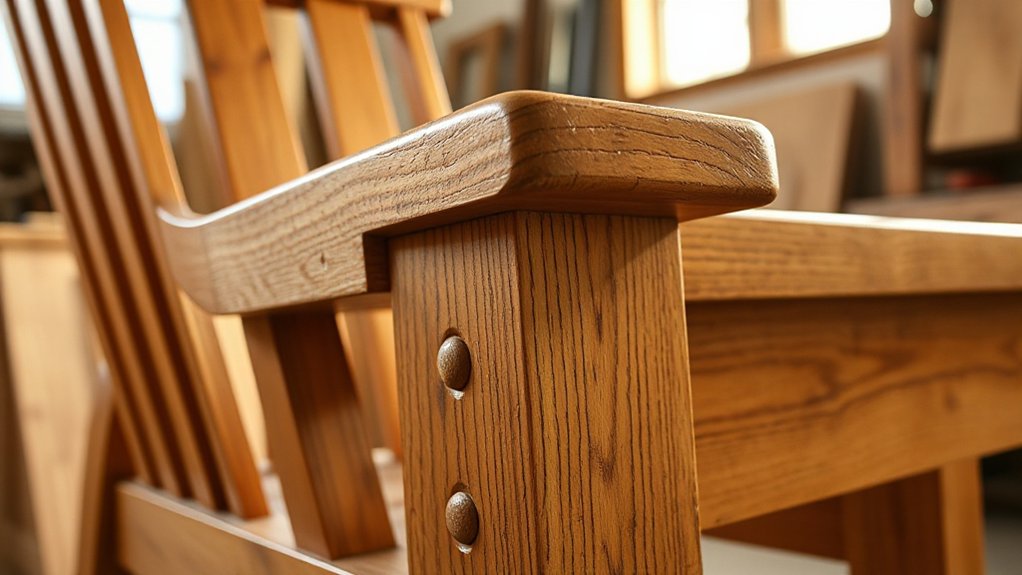
When you look closely at a Mission piece, the joinery usually gives away whether it’s the real deal or a lookalike. You’ll spot mortise-and-tenon work where rails meet stiles, often left proud to show confidence in the cut. Run your fingers along corners: tight shoulders and consistent reveals suggest careful marking out, not rushed factory assembly. Pegs should read as structural, not merely decorative, and you’ll often see them pinning tenons through the face.
- Through-tenons with crisp arrises and no filler
- Square pegs set slightly proud, aligned across rails
- Slats housed in grooves, not stapled or bradded
If a piece leans Art deco or Mid century, it may simplify profiles, but sound rails, pegs, and tenons still do the work.
Mission Finishes: Fumed Oak and Warm Stains
To judge Mission finishes properly, you need to know how fumed oak develops its patina, as ammonia reacts with the timber’s tannins to darken it from within rather than sitting on the surface. You’ll spot the best examples by their even, mellow depth and lack of muddy pigment in corners and around joints. When you’re choosing warm stains instead, keep to controlled ranges—from honey and amber through chestnut to deep walnut—so the grain stays crisp and the piece still reads as honest oak.
Fumed Oak Patina Process
As you chase that unmistakable Mission look, fumed oak gives you a deep, smoky patina that comes from a chemical reaction rather than a surface coating. You expose tannin-rich oak to ammonia fumes in a sealed chamber, and the wood darkens from within, keeping pores crisp and ray fleck pronounced. This method makes Patina development consistent across profiles, yet it still rewards careful preparation and control.
- Use white oak for higher tannin content and steadier results.
- Plane and sand uniformly; uneven milling shows up as blotchy fuming.
- Regulate exposure time, temperature, and ventilation, then neutralise and de-gas fully before finishing.
You’ll handle ammonia with gloves and eye protection, and you’ll test offcuts first to lock in your process.
Warm Stain Color Ranges
A warm stain palette lets you dial in the Mission look without the full fuming set-up, shifting oak from honey and golden brown through nutty mid-browns to deeper chestnut and near-walnut tones. You’ll keep ray fleck visible if you choose transparent dyes, then lock it in with a thin seal coat before waxing or varnishing.
Use colour psychology to guide selection: lighter ambers read open and welcoming in small rooms; richer browns feel grounded and formal beside blackened ironwork. Test on offcuts and view in daylight and lamplight, because oak’s tannins can skew warmer than the tin suggests. For furniture care, avoid silicone polishes, wipe spills promptly, and refresh the finish with a light de-nib and top-up coat when it dulls.
Iconic Mission Pieces (Chairs, Tables, Sideboards)
Where do you see Mission style at its most unmistakable? You’ll spot it in the honest geometry of chairs, tables, and sideboards, where thick uprights, exposed joinery, and broad planes do the heavy lifting. Choose a slatted-back armchair for a reading corner; it gives firm support and a disciplined silhouette without fuss. Pick a rectilinear dining table when you need everyday resilience—square legs and a sturdy apron resist knocks and wobble. Add a sideboard to organise linens and crockery; its flat top doubles as a serving station while doors and drawers keep clutter shut away. Look for:
- Decorative motifs cut as simple inlays or corbels
- Cultural influences from Arts and Crafts restraint
- Proportions that prioritise function over ornament
Stickley and Other Makers to Know
Even if you can’t name the details, you’ll recognise Mission style fastest through Gustav Stickley, whose plain-sawn oak, exposed pegged joinery, and purposeful proportions set the benchmark. If you want to understand the movement, track Stickley’s Craftsman Workshops output and his magazine-driven design programme, which linked honest construction to everyday living.
You should also know the Stickley brothers’ firms (L. & J.G., Leopold, and Charles), which often pushed heavier silhouettes and bolder through-tenons. Roycroft communities added hand-hammered copper and a more artisanal finish, while Limbert leaned into lighter forms and subtle Dutch cut-outs. These makers show the Historical influences of Arts and Crafts ideals, yet they’ve fuelled Modern adaptations in today’s oak, walnut, and mixed-material ranges.
How to Spot Real Mission Furniture vs Repros

Once you’ve got the key makers in mind, you can judge whether a piece really comes from the Mission era or just borrows the look. Start with the timber: genuine examples favour quarter-sawn oak with visible ray flecking, not flat-sawn boards stained to imitate it. Then inspect joinery; period work shows through-tenons, tight mortise-and-tenon joints, and consistent tool marks, rather than staples or loose dowels.
- Check patina: natural wear on arms, edges, and feet, not uniform “antique” shading
- Look underneath: old screws, hand-cut slots, and oxidised metal, not bright zinc fittings
- Read the design: proportions and restraint reflect Historical influences, while exaggerated slats and heavy lacquer often signal Modern reinterpretations
Finally, confirm provenance with labels, catalog references, or documented ownership.
Mission vs Craftsman vs Shaker (Fast Comparison)
Although people often lump them together, Mission, Craftsman, and Shaker differ in both intent and detail. If you want the quick read: Mission prioritises rectilinear form, visible joinery, and quarter-sawn oak; it grew from Historical influences like the Arts and Crafts movement and early American interiors. Craftsman shares the same honesty, but you’ll often see heavier proportions, exposed pegs, and built-in thinking that suits whole-room schemes. Shaker sits apart: you get lighter frames, minimal ornament, and a stricter focus on utility and religious restraint. When you’re shopping, check the silhouettes first, then the timber choice and hardware. For Modern adaptations, expect Mission and Craftsman to keep bold slats, while Shaker morphs into pared-back cabinetry and painted finishes.
Frequently Asked Questions
Is Mission Style Furniture Comfortable for Everyday Sitting and Lounging?
Yes, you’ll find mission style furniture comfortable for everyday sitting and lounging if you choose pieces with Ergonomic design and decent Cushion comfort. You’ll want supportive seat depth, firm padding, and footstools for longer rests.
How Do I Care for and Clean Mission Furniture Without Damaging the Finish?
Dust with a soft, dry cloth, then wipe with a barely damp microfibre. Use mild soap only when needed, dry promptly. For wood finish maintenance, avoid abrasives, ammonia, polish build-up; test cleaning methods first.
What Should I Expect to Pay for Antique Mission Pieces Today?
You should expect to pay £500–£5,000+ for antique Mission pieces, depending on maker, condition, provenance, and rarity. In the antique market, price fluctuations are common; use dealers’ catalogues, auctions, and condition reports.
Does Mission Furniture Work Well in Modern or Minimalist Interiors?
Yes, you can make Mission furniture work brilliantly in modern or minimalist rooms if you keep lines uncluttered and let its historical influence anchor the space. Use restrained decorative accents, neutral palettes, and balanced proportions.
Can Mission-Style Furniture Be Sustainably Sourced or Fsc-Certified?
Yes, you can buy mission-style furniture with sustainable sourcing and FSC certification. You’ll need to check chain-of-custody paperwork, specify solid timber, and choose makers using low-VOC finishes. Ask your retailer for certificates.
Conclusion
You’ve now got Mission style furniture practically memorised: bold slats, square lines, honest heft, and joinery so overbuilt it could survive a small apocalypse. You’ll recognise oak and other sturdy timbers, spot tenons, pegs, and rails, and name-check Stickley without blinking. When you compare Mission with Craftsman and Shaker, you won’t muddle them again. Use these clues in the shop, trust your eyes, and you’ll dodge reproductions with ease.