
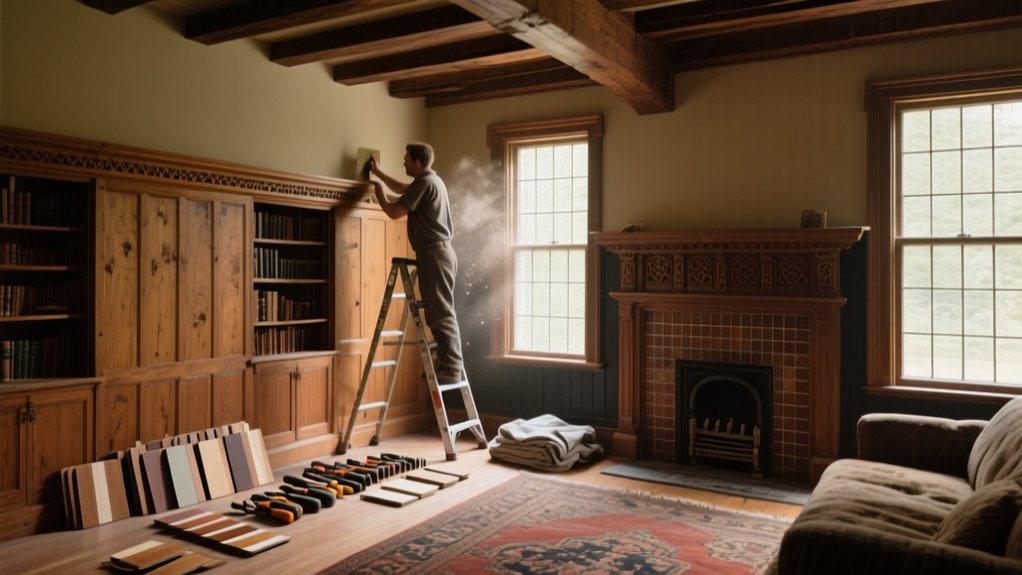

When you restore an Arts and Crafts home, you’re managing more than cosmetic upgrades; you’re working with structural systems, historic fabric, and period-specific detailing that demand disciplined decision-making. You must evaluate framing, masonry, and original millwork, then balance building-code compliance, energy performance, and authenticity. Every choice—finish schedule, hardware specification, mechanical retrofit—either reinforces or erodes the house’s integrity, so before you finalize your scope of work, you need to contemplate…
Key Takeaways
- Begin with a thorough structural and envelope assessment, prioritizing foundation, roof, and water-intrusion repairs before any cosmetic or interior work.
- Preserve original woodwork, built-ins, and hardware through repair and consolidation, commissioning custom replacements only when elements are missing or beyond salvage.
- Improve comfort and efficiency with careful air sealing, vapor-permeable insulation, and high-efficiency, zoned HVAC that respect the house’s historic fabric.
- Use period-appropriate finishes and colors: low-sheen oils, varnish or shellac, muted earth-tone paints, and mission-style hardware consistent with Arts and Crafts details.
- Furnish and light interiors with rectilinear, modestly scaled furniture, warm-color-temperature fixtures, and handcrafted textiles that complement the home’s wood tones and proportions.
Assessing Your Arts and Crafts Home’s Bones
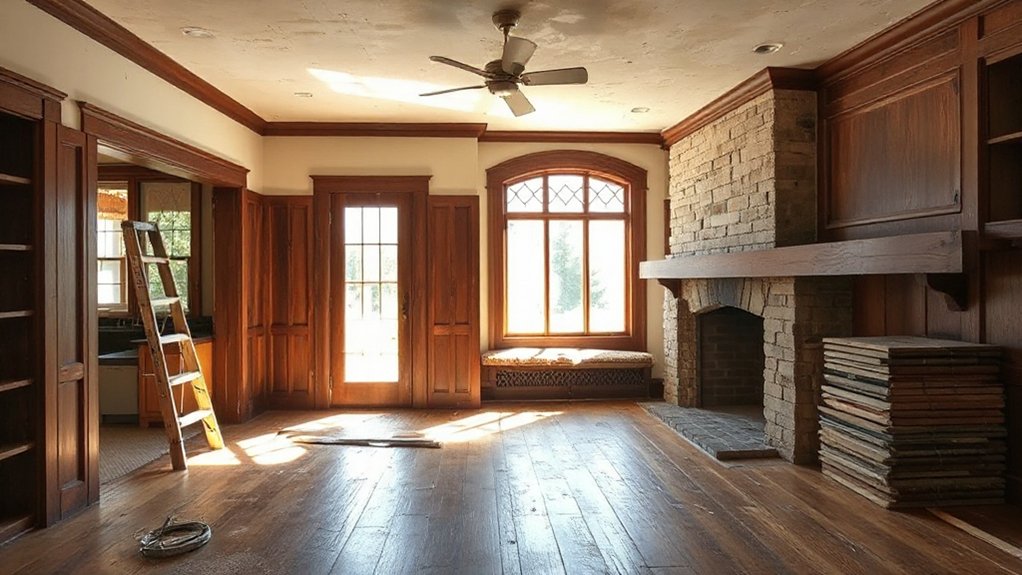
Before you begin any restoration work, you must systematically evaluate the structural and architectural integrity of your Arts and Crafts home to understand what’s original, what’s been altered, and what’s failing.
You start with structural integrity: inspect foundations for differential settlement, masonry cracking, and moisture intrusion; probe sill plates, joists, and beams for rot, insect damage, or deflection. Verify roof framing alignment and load paths from rafters to bearing walls.
Next, analyze architectural details. Document millwork profiles, built-ins, stair components, and window and door assemblies, distinguishing period fabric from later interventions. Examine plaster systems, wood species, and joinery techniques to confirm authenticity.
Record all conditions photographically and in written form so you can prioritize stabilization and preserve character-defining elements.
Defining a Restoration Plan and Budget
You now translate your structural assessment into a phased restoration plan by systematically documenting existing conditions, character-defining features, and code or life-safety deficiencies.
From this baseline, you’ll establish a scope of work that distinguishes critical stabilization and envelope repairs from discretionary enhancements.
With that hierarchy in place, you can align priorities with a realistic budget, sequencing work to control costs while preserving the home’s architectural integrity.
Assessing Existing Conditions
How thoroughly you assess existing conditions will determine the accuracy of your restoration plan and budget for an Arts and Crafts home. You begin with historical research: original drawings, permit records, photographs, and prior inspection reports establish baseline construction methods, materials, and significant alterations.
This documentation lets you distinguish character-defining features from later intrusions.
Next, you perform a systematic structural assessment. Examine foundations, load‑bearing walls, sill plates, and roof framing for settlement, deflection, rot, or insect damage. Use moisture meters, borescopes, and probe tests to verify concealed conditions without unnecessary demolition.
Document existing utility systems, window assemblies, masonry, and interior finishes, noting code deficiencies and material failures. Quantify deterioration and map it on floor plans to support accurate scope, cost allowances, and contingencies.
Prioritizing Scope And Budget
Once existing conditions are documented, you translate findings into a prioritized restoration scope aligned with budget, risk, and preservation objectives. You first address life-safety, structural stability, and water-intrusion items, then sequence enclosure, systems, and interior finishes.
You classify each task as critical, recommended, or elective, tying it to specific building components and projected service life.
You then assemble a line-item budget, including allowances for material sourcing, artisan labor, contingencies, and regulatory compliance. You evaluate options by comparing lifecycle costs against gains in historical accuracy and performance.
Where funds are constrained, you phase work over multiple campaigns, preserving future reversibility. Throughout, you reconcile scope with funding capacity, ensuring every expenditure demonstrably advances the home’s architectural integrity and long-term resilience.
Preserving Original Woodwork, Trim, and Built-Ins
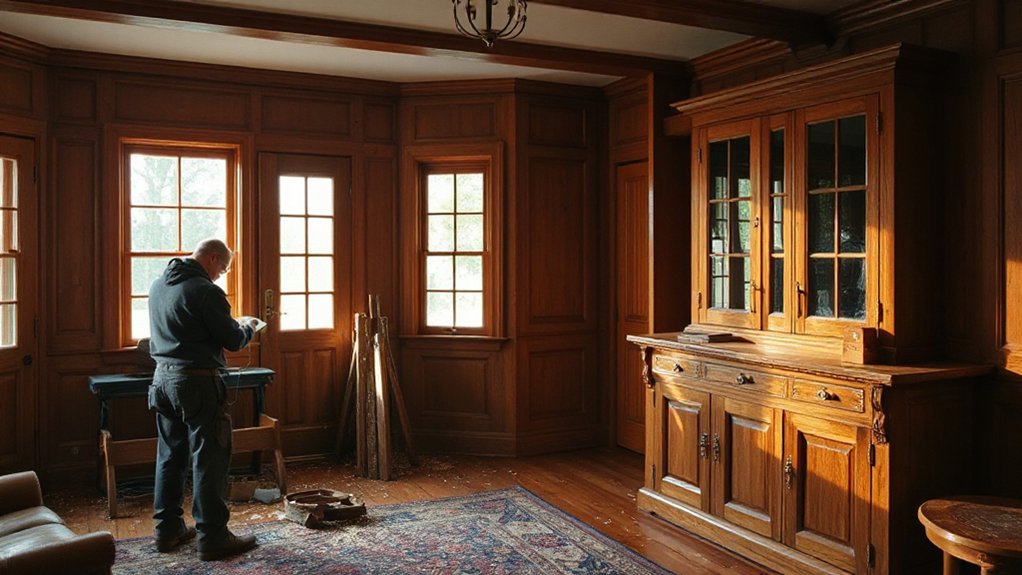
Although finishes and floor plans often change over time, original woodwork, trim, and built-ins typically define an Arts and Crafts home’s architectural character and historical integrity. You should treat these assemblies as primary assets in any historic preservation strategy, retaining as much fabric as possible and limiting invasive intervention.
Begin with a conditions assessment, documenting profiles, joinery, and species to guide any custom woodworking required for missing or severely deteriorated elements. Use consolidants, dutchman repairs, and epoxy infill selectively, maintaining original tool marks and reveal lines.
- Identify and catalog casing, base, crown, and wainscot profiles
- Test-clean surfaces to remove contaminants without damaging substrate
- Repair sash, doors, and cabinet faces using matching lumber and joinery
- Commission custom woodworking only where replication is absolutely necessary
Selecting Period-Appropriate Colors and Finishes
During color and finish selection for an Arts and Crafts home, you must balance documentary evidence, period palettes, and existing material conditions to maintain historical fidelity. Begin by conducting a stratigraphic paint analysis to identify original hues and sheen levels, then correlate findings with historic manufacturer charts and pattern books.
You should favor earth-derived pigments—oxides, umbers, and ochres—in muted, low-chroma values that reinforce the movement’s material honesty. Specify traditional paint techniques such as flat or matte wall coatings, varnished or shellacked woodwork, and casein or distemper where appropriate.
Calibrate finish textures carefully: avoid high-gloss films, and instead employ rubbed oil, waxed shellac, or satin varnish to articulate grain without visual glare. Maintain a coherent, room-to-room chromatic hierarchy that emphasizes millwork and built-ins.
Updating Kitchens and Baths Without Losing Character
When you update kitchens and baths in an Arts and Crafts home, you must balance modern performance standards with period-authentic detailing.
You’ll select cabinetry with appropriate door profiles, frame construction, and wood species that reference original millwork while accommodating contemporary storage systems.
At the same time, you’ll integrate modern fixtures and appliances in a visually recessive manner—through concealed technologies, compatible finishes, and scaled hardware—so they support rather than disrupt the architectural character.
Period-Appropriate Cabinetry Choices
How do you introduce modern functionality into kitchens and baths while preserving the Arts and Crafts vocabulary of honest construction, simple massing, and expressive joinery? You begin with rigorous cabinet material selection and disciplined hardware design that align with original fabric and craftsmanship standards.
Specify face-frame, inset-door construction, avoiding overlay systems that read contemporary. Prioritize quartersawn white oak or maple, using solid wood frames and veneered panels for dimensional stability. Maintain rectilinear door profiles and rail‑and‑stile proportions consistent with adjacent millwork.
- Use through or blind mortise-and-tenon joints where visible.
- Select square-edged, oil-rubbed bronze or blackened steel pulls.
- Align cabinet reveals with existing window and door casings.
- Standardize stile and rail dimensions to echo period built-ins.
You’ll achieve functional upgrades without aesthetic discontinuity.
Integrating Modern Fixtures Subtly
With cabinetry calibrated to the original envelope, fixture selection becomes the next determinant of visual coherence in updated kitchens and baths. You should specify fixtures with restrained profiles, oil-rubbed or patinated finishes, and forms compatible with rectilinear Arts and Crafts geometry.
Prioritize under-mount or apron-front sinks and low-profile induction or gas hobs with minimal visual clutter.
Integrate Smart lighting through dimmable, warm-temperature LEDs housed in simple metal or opaline glass shades that echo period luminaires. Use Hidden wiring within walls, cabinet chases, and soffits to avoid surface-mounted conduits that disrupt millwork.
Select thermostatic shower valves and low-flow faucets with cross or lever handles that reference early-20th-century hardware, ensuring modern performance while preserving visual continuity with original detailing.
Improving Comfort and Efficiency in an Old House
Why does a meticulously restored Arts and Crafts house often still feel drafty, unevenly heated, or expensive to operate? You’re dealing with assemblies designed before modern Energy efficiency standards.
To improve performance without compromising character, you must treat the building envelope, mechanical systems, and air movement as an integrated system.
Begin with targeted insulation upgrades, guided by blower-door testing and infrared imaging, so you don’t trap moisture in original framing.
Then address stack-effect drafts and uncontrolled infiltration at basements, attics, and around original windows.
- Air-seal gaps at rim joists, attic penetrations, and service chases
- Specify vapor-permeable insulation for roof and wall cavities
- Commission right-sized, high-efficiency HVAC with zoned controls
- Install smart thermostats and TRVs to stabilize room-by-room comfort
Choosing Craftsman-Style Fixtures, Furniture, and Details
Once the building envelope and systems perform reliably, the house can support the visual and tactile integrity that defines the Arts and Crafts idiom.
You should begin with a coherent material palette: quarter-sawn oak, stained fir, or walnut, finished with low-sheen penetrating oils.
Select furniture with rectilinear profiles, exposed joinery, and minimal applied ornament, maintaining appropriate scale for narrow rooms and low plate heights.
Specify antique lighting or high-quality reproductions with mica, opalescent glass, and darkened metal finishes; verify Kelvin temperature and lumen output to emulate incandescent warmth.
Integrate handcrafted textiles—block-printed linens, woven wool runners, and appliquéd pillows—to soften the architecture while reinforcing geometry and color.
Finally, detail doors and built-ins with mission hardware, mortise locks, and period-accurate backplates.
Frequently Asked Questions
How Do I Identify if My House Is Truly Arts and Crafts Style?
You verify Arts and Crafts authenticity by evaluating Craftsman details: low-pitched gable roof, exposed rafter tails, substantial porch piers, built-in cabinetry, natural materials, and Interior design emphasizing handcrafted woodwork, rectilinear profiles, earth-tone palettes, and minimal applied ornamentation.
Can I Mix Mid-Century Furniture With Arts and Crafts Architecture?
Yes, you can; “form follows function” applies. You’ll integrate Modern furniture with Arts and Crafts detailing by maintaining scale compatibility, natural materials, and cohesive color temperature, while curating streamlined Interior accessories to avoid visual noise and stylistic discord.
What Exterior Landscaping Complements an Arts and Crafts Home?
You’ll complement the exterior with asymmetrical beds of native plantings, layered by canopy, understory, and groundcover, integrated with natural materials—stone edging, gravel paths, timber pergolas—and low garden walls that reinforce horizontality and site-responsive design.
How Do I Find Contractors Experienced With Arts and Crafts Restoration?
Consult conservation contractors through preservation societies, scrutinize portfolios for artisan craftsmanship, verify historical preservation credentials, request references from prior restorations, and confirm familiarity with period-appropriate materials, joinery, and millwork specifications before drafting detailed scopes, schedules, and fixed-price contracts.
Are There Grants or Tax Credits for Historic Arts and Crafts Restorations?
You can typically access grants and tax credits through historic preservation agencies and IRS-recognized tax incentive programs. Verify local landmark designation, meet the Secretary of the Interior’s Standards, and consult state historic preservation offices for eligibility and application compliance.
Conclusion
As you complete your restoration, you’re not just repairing a structure; you’re calibrating a finely tuned instrument. Every preserved stile-and-rail door, shellacked trim, and hand-rubbed finish becomes a datum point in a larger system of integrity. By integrating high‑performance envelopes, sympathetic MEP upgrades, and period‑correct fixtures, you align old-growth lumber and new building science. In doing so, you turn your Arts and Crafts home into a well-balanced gauge of timeless craftsmanship and modern resilience.