
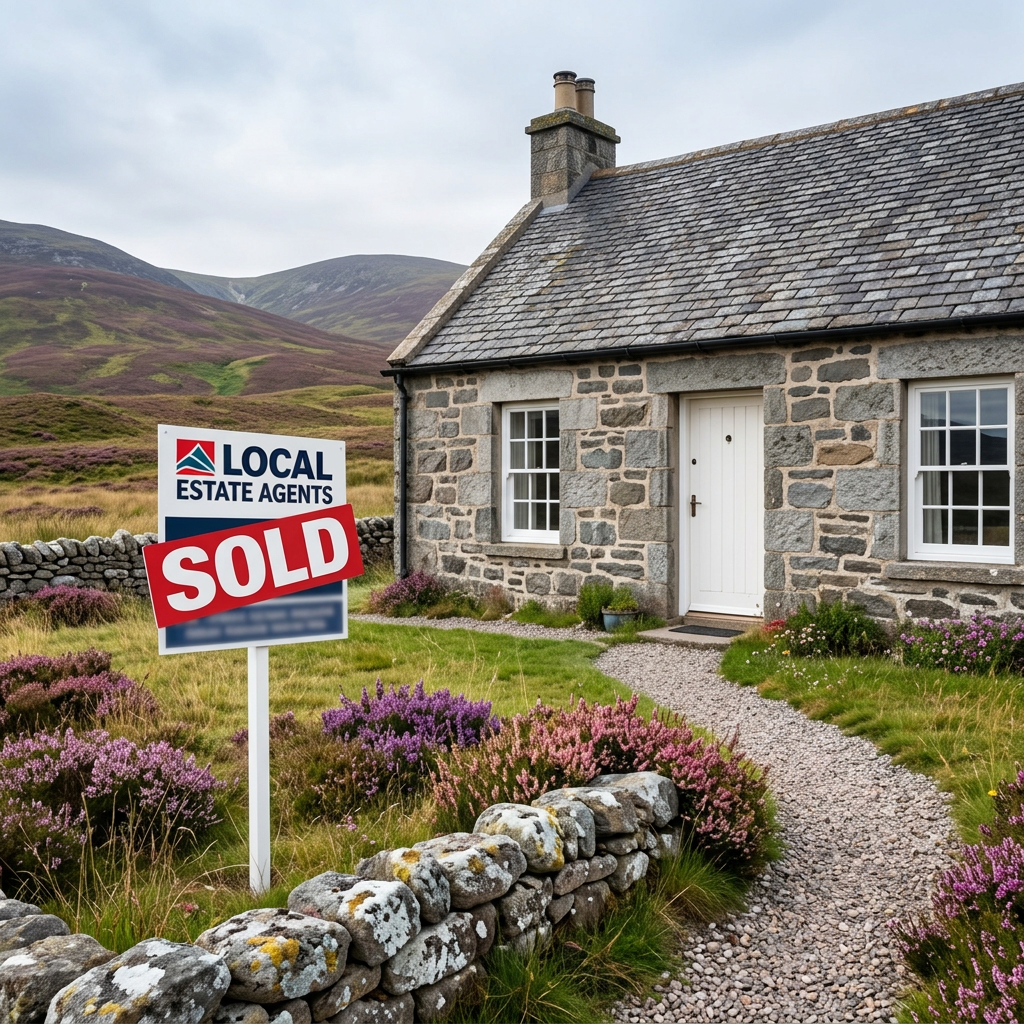

Scotland offers one of the most varied and most genuinely rewarding cottage markets in Britain — from the stone-built croft houses of the Hebrides to the sandstone farmhouses of Dumfries and Galloway, from the estate cottages of Perthshire to the whitewashed village properties of the East Neuk of Fife. Local estate agents, come into their own, in these types of areas due to knowledge of the towns and locality when looking for rural properties such as cottages for sale in Scotland.
The variety of landscape, building tradition, and price is extraordinary, and the right area depends almost entirely on what you want from a Scottish cottage: a holiday retreat, a permanent home, a working rural property, or a rental investment.
Key Takeaways
- Scotland’s average house price of £188,807 at the end of 2024 is significantly below the UK national average — and rural cottage prices in many areas sit well below this, making Scotland one of the most accessible cottage markets in Britain for buyers from higher-price English regions, according to official government data published.
- The Scottish Highlands offer the most dramatic landscape and the widest range of property types — from accessible Speyside and Inverness-shire to the remotest parts of the northwest coast, the Highlands span an enormous range of lifestyle propositions at very different price points.
- Perthshire and Stirlingshire offer the best combination of accessibility and rural character — within two hours of Edinburgh, Glasgow, and the central belt, with outstanding landscape and a strong local property market.
- Dumfries and Galloway is Scotland’s best-value cottage region — traditional stone-built properties at prices that are often half those of comparable Highland or Perthshire properties, in a genuinely beautiful and underrated landscape.
- The Scottish Borders offers character and accessibility — historic market towns, rolling countryside, and prices that have been rising more slowly than elsewhere in Scotland, creating value for buyers willing to look beyond the more fashionable Highland and west coast markets.
- The islands — Skye, Mull, Arran, and the outer islands — offer the most dramatic settings at the highest price premium — accessibility, infrastructure, and year-round practicality must be carefully assessed before purchasing island property.
- Scottish property law differs significantly from English property law — the offers over / offers around pricing system, the closing date process, and the role of the solicitor in Scottish transactions all require specific understanding before committing to purchase.
The Scottish Highlands
The Scottish Highlands is the largest and most varied of Scotland’s rural regions, and it contains the full spectrum of Scottish cottage buying — from highly accessible properties near Inverness and the Cairngorms to genuinely remote croft houses and estate properties in the far northwest.
Inverness-shire and the Cairngorms
The area around Inverness and the Cairngorms National Park offers what may be the most practical version of Highland cottage living — dramatic landscape within a manageable distance of a city with an international airport, a university, and a full range of services. The Cairngorms — the largest national park in the UK — contains some of the most sought-after small towns and villages in the Highlands: Aviemore, Grantown-on-Spey, Kingussie, Newtonmore, Ballater, and Braemar all have active property markets with regular cottage listings.
Properties in this region range from converted Victorian villas and estate cottages in established villages to more rural farmhouses with land on the periphery of the park. The national park designation limits development and maintains landscape quality, which is reflected in relatively strong price performance.
Average property values in Scotland were up 4.5% on the previous year at the start of 2026, and the Highlands, while growing more slowly than some urban areas, benefits from sustained demand from buyers seeking both permanent homes and holiday lets.
Speyside and the Moray Coast
The Moray Coast — the stretch of coastline from Nairn east to Buckie — and the inland Speyside valley offer cottage properties in a setting that is often overlooked in favour of the more publicised west coast and islands. The coastline has a distinct character — fishing villages, stone-built harbour towns, and some of the best farmland in Scotland — and the combination of coast, river valley, and the Cairngorms to the south produces a landscape of genuine quality.
Prices in this area tend to be more accessible than the Cairngorms heartland, and the area’s relative obscurity on the national cottage market means that buyers willing to research it are rewarded with value that the more fashionable regions do not offer.
The Northwest Highlands and Sutherland
The northwest Highlands — Wester Ross, Sutherland, and Caithness — offer the most dramatic and most remote Highland landscape, at prices that reflect both the beauty of the setting and the practical challenges of remoteness. Properties here include traditional stone croft houses, converted estate cottages, and occasional larger farmhouses with significant land.
Buyers in this area need to assess practical considerations that do not apply in more accessible regions: mobile and broadband connectivity, distance from medical services, the condition of single-track road access, and the cost of building work in areas where trade contractors are scarce and materials expensive to transport. For buyers who have done this due diligence and are committed to the lifestyle, the northwest Highlands offers a quality of landscape and a sense of place that is genuinely unmatched in Britain.
Perthshire and Stirlingshire
Perthshire is one of Scotland’s most consistently popular regions for cottage buyers, and the reasons are easy to understand. The landscape — rolling farmland, river valleys, ancient woodland, and the southern edge of the Highlands — is among the most varied and most beautiful in Scotland. The accessibility from the central belt (Perth is approximately 45 minutes from Edinburgh by road; Stirling is the gateway between the Lowlands and the Highlands) makes it realistic for buyers who want rural character without total remoteness. And the building stock — stone-built farmhouses, estate cottages, and Victorian villas in established towns like Crieff, Pitlochry, Aberfeldy, and Dunkeld — is of generally high quality.
Perthshire properties, including historic cottages near Callander and farmhouses outside Dunkeld, offer a blend of countryside living and accessible amenities that buyers from England and the central belt consistently respond to.
Pitlochry and the Tay Valley are particularly active cottage markets — the combination of good road and rail connections (the A9 and the Highland Main Line pass through), tourist infrastructure, and outstanding landscape drives both permanent buyer and holiday let demand. Properties suitable for holiday letting in this area have performed well as investments, with strong occupancy rates reflecting the area’s year-round appeal.
Stirlingshire — the area around Stirling, the Trossachs, and the southern Highlands — offers slightly lower prices than the more established Perthshire market for equivalent properties, with access to similar landscape and the added benefit of proximity to Glasgow (approximately 30 minutes from Stirling).
Dumfries and Galloway
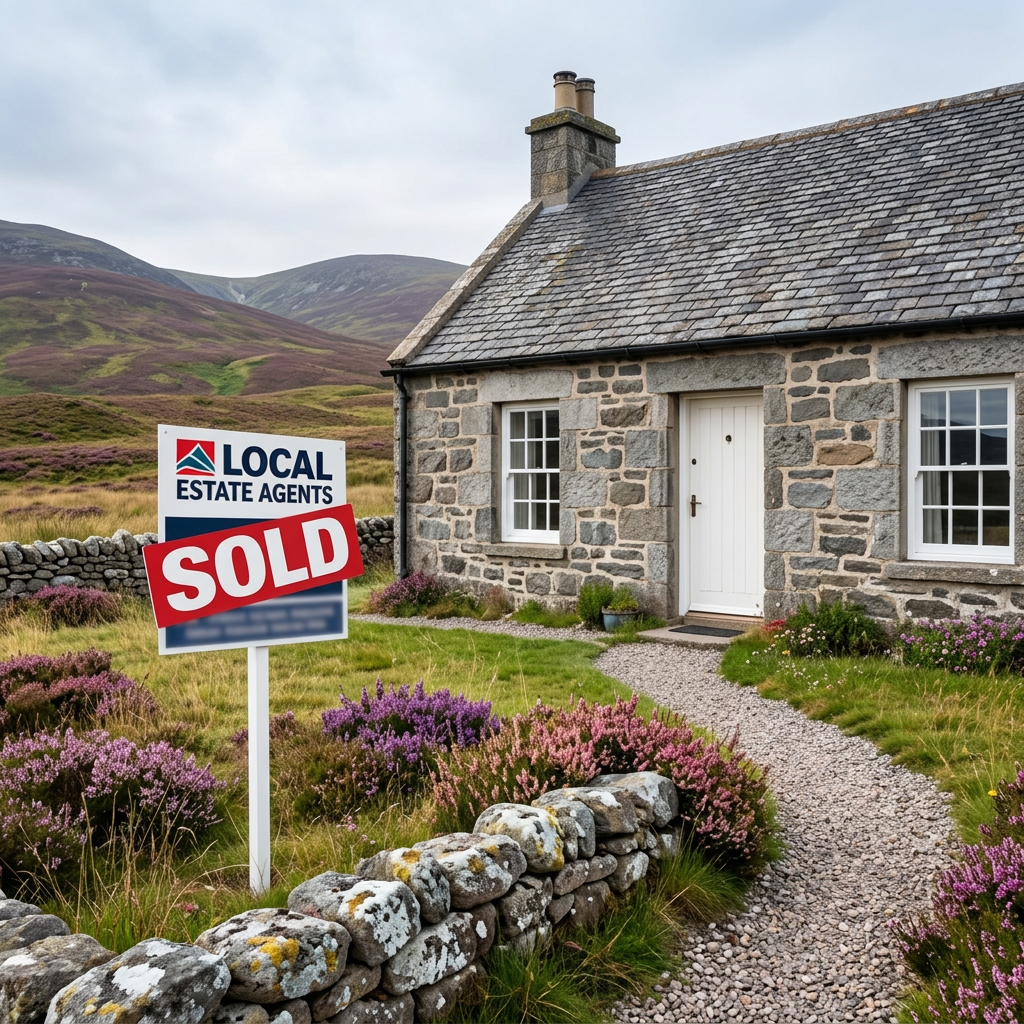
Dumfries and Galloway is Scotland’s most underrated cottage region and, in terms of value for money, arguably its best. The region — Scotland’s southwest corner, bordering the Solway Firth and the English Lake District — has a distinct building tradition: solid stone farmhouses, traditional Galloway cottages in local sandstone or whitewashed render, and occasional converted estate buildings in a landscape of rolling hills, ancient woodland, and coastline.
The Dumfries and Galloway market includes traditional Galloway cottages with land and stables near Castle Douglas, rural smallholdings in the Galloway countryside, and three-bedroom traditional stone cottages in picturesque villages — all at prices that represent exceptional value compared to more fashionable Scottish regions.
Towns like Castle Douglas, Kirkcudbright (an artists’ town with a strong creative community), Newton Stewart, and Dalbeattie serve as attractive market town centres for the surrounding cottage market. Castle Douglas in particular has developed a reputation as a food town, with a strong independent retail and restaurant culture that makes it an increasingly attractive base for buyers relocating from cities.
The practical advantages of Dumfries and Galloway for buyers from England are significant: the region is closer to London than either Edinburgh or Glasgow by road (the M6 reaches the border at Carlisle, from which the A75 crosses Dumfries and Galloway to Stranraer), and property prices consistently sit well below those in more accessible Scottish regions. The compromise is relative remoteness from Scottish cities and the lower-profile cultural and commercial infrastructure of a less densely populated region.
The Scottish Borders
The Scottish Borders — the historic counties of Berwickshire, Roxburghshire, Selkirkshire, Peeblesshire, and Dumfriesshire — occupy the sweep of land between the English border and the Edinburgh commuter belt. The landscape is characteristically rolling and pastoral, with the distinctive rounded Border hills framing river valleys and the market towns of Hawick, Kelso, Jedburgh, Galashiels, and Peebles.
The Borders property market has historically been quieter than the more dramatic Scottish regions and has therefore offered good value for buyers who are prepared to look beyond the well-known Highland and island cottage markets. Prices in the Borders have been rising more slowly than other Scottish regions, with annual price growth five to seven times slower than the fastest-growing areas — which creates value for buyers attracted to the area’s genuine character.
The building stock in the Borders reflects the region’s agricultural and textile heritage — stone-built farmhouses and estate cottages in local grey sandstone or red sandstone, typically solidly constructed and often with good land attachments. The larger properties in the region — farmhouses with tens or hundreds of acres — have traditionally attracted buyers from the south of England seeking working rural properties at a significant discount to equivalent properties in the Home Counties.
Accessibility from Edinburgh (Hawick is approximately 50 miles; Peebles approximately 23 miles) makes the inner Borders viable for Edinburgh-based buyers who want rural character. The lack of mainline railway connection to most of the region (Tweedbank on the Borders Railway is the closest mainline station to many Border towns) is the most significant practical limitation.
Argyll and the West Coast
The west coast of Scotland — Argyll, Kintyre, and the hinterland north toward Fort William — offers a very different cottage proposition from the accessible Perthshire and Border markets. The landscape is dramatic (lochs, mountains, sea inlets, and island views), the building tradition is of whitewashed or harled stone cottages, and the accessibility is challenging — much of the region is reached by single-track roads, and ferries are required for the peninsula communities and islands.
Inveraray, Lochgilphead, Tarbert, and Campbeltown serve as the principal market towns. Properties range from traditional whitewashed cottages in established villages to more isolated farmhouses with substantial land.
The west coast market is strongly influenced by the holiday let and second home market — the landscape and the accessibility of the region from Glasgow (the Cowal peninsula is approximately 90 minutes from Glasgow via Gourock ferry) make it an attractive holiday property market. This demand has pushed prices in the most accessible west coast locations above those that the local economy would support, creating a market in which buyers are essentially paying a premium for the landscape.
The Islands: Skye, Mull, Arran, and Beyond
Scottish island property is a category of its own, and it deserves careful assessment before any purchase commitment is made.
Isle of Skye is the most popular and most accessible of the Scottish islands for cottage buyers — the Skye Bridge eliminated the need for a ferry crossing in 1995, and the growth of tourism has created a year-round economy that makes full-time residence more practical than on more remote islands. Cottages in popular tourist areas like the Isle of Skye command significant premiums over equivalent properties in less fashionable locations — the Portree area, Dunvegan, and the Sleat peninsula all have active markets but at prices that reflect the island’s popularity.
Isle of Arran — “Scotland in miniature,” as it is commonly described — offers accessible island living within an hour of Glasgow by ferry from Ardrossan. The island has a strong year-round community, reasonable amenities, and a property market that reflects its popularity with both permanent buyers and holiday let investors.
Isle of Mull and the Inner Hebrides offer more genuine remoteness than Skye or Arran. Properties require a ferry crossing (Oban to Craignure for Mull), and the island’s infrastructure, while improving, requires realistic assessment. Mull has attracted significant inward migration from buyers seeking a quieter, genuinely rural life, and property prices have responded accordingly.
The outer islands — the Outer Hebrides (Lewis, Harris, North Uist, South Uist, Barra), Orkney, and Shetland — offer the most remote and the most characterful cottage properties in Scotland. Traditional black houses on Harris, former croft houses with extensive land on Uist, and the Norse-influenced stone properties of Orkney and Shetland are genuinely distinct building traditions found nowhere else in Britain. The practical challenges are correspondingly significant — ferry or flight access only, limited services, challenging climate, and building work that is difficult and expensive in remotely located properties.
Understanding Scottish Property Law
Buyers from England, Wales, and Northern Ireland need to understand that Scottish property law operates differently from the rest of the UK in several important respects.
Offers over / offers around: Most Scottish properties are marketed at “offers over” a stated price, meaning the marketing price is typically below the expected sale price. The actual price achieved depends on the level of competing interest. Buyers should not assume they can offer the marketed price and secure the property; they must research comparable sales and assess the level of interest before making an offer.
The closing date process: When multiple buyers express interest in a property, the seller’s solicitor typically sets a closing date — a specific date and time by which all offers must be submitted in sealed form. Buyers who miss the closing date are excluded from the process. This creates a process that feels significantly more formal and more compressed than the English offer and negotiation model.
The role of the solicitor: In Scotland, the solicitor plays a central role in the offer process from the outset — it is normal practice in Scotland to have your solicitor make the offer on your behalf. Engaging a Scottish solicitor before you begin seriously viewing properties is strongly recommended.
No binding contract before missives: The contract in a Scottish property transaction is concluded when both parties’ solicitors exchange formal letters (missives). Before missives are concluded, either party can withdraw without penalty. This means that in Scotland, as in England, the period before contract conclusion carries gazumping risk.
Specialist agents: Scottish rural property — particularly farms, estates, and remote highland properties — is handled by specialist agents including Galbraith, Bidwells, Bell Ingram, Strutt & Parker (Scotland), and Savills (Scotland). These firms handle a significant proportion of the Highland, Borders, and rural Scottish property market and are the primary source for properties that do not appear on mainstream portals.
Starting Your Search
For buyers beginning a search for cottages for sale in Scotland, the following resources provide the broadest market coverage:
ESPC (Edinburgh Solicitors Property Centre) — the primary property portal for Edinburgh and the Lothians.
S1Homes — a portal covering the wider Scottish market.
Rightmove and Zoopla — mainstream portals with Scottish coverage, though some solicitor/agent combinations post exclusively to Scottish portals.
Galbraith, Bell Ingram, Bidwells, and Strutt & Parker Scotland — the specialist rural agencies whose stock includes properties not on mainstream portals.
SALVO — the website for properties involving architectural salvage and reclaimed material — occasionally relevant in the Highland and island cottage market where historic building fabric is a significant value factor.
Scotland’s cottage market rewards buyers who take the time to understand the specific region they are interested in, engage with local agents and solicitors early in the process, and visit extensively before committing. The diversity of landscape, building tradition, lifestyle, and price across Scotland’s regions is extraordinary — and the right cottage in the right region is one of the most rewarding property purchases available in Britain.