


Georgian furniture looks refined because you’re seeing architecture translated into wood: strict symmetry, calm proportions, and disciplined ornament. You’ll spot balanced elevations, grid-like drawer layouts, and classical cues like fluted pilasters, pedimented tops, and shallow shell or rosette carving that casts crisp shadow. Mahogany or walnut often glows under shellac and wax, while book-matched veneer and tidy brass hardware show precision. Keep going and you’ll learn how to date key forms and style them today.
Key Takeaways
- Georgian furniture prioritizes symmetry, balanced proportions, and calm refinement, using architectural logic rather than heavy decoration.
- Classical influences appear in pediments, fluted pilasters, acanthus, and shell motifs, carved crisply in shallow relief for controlled shadow.
- Mahogany, walnut, and oak dominate, often with book-matched veneers, crossbanding, and shellac-wax finishes that develop genuine patina.
- Quality is shown by tight joinery, hand-cut dovetails, stout dustboards, precise hardware alignment, and well-proportioned legs with cleanly carved feet.
- In modern interiors, use Georgian pieces as disciplined anchors, pairing them with minimal lighting and quieter upholstery to preserve their ordered harmony.
What Is Georgian Furniture (and Why It Matters)?

So what is Georgian furniture, and why should you care? You’re looking at British design from the early 1700s through the early 1800s, shaped by classical ideals and the era’s expanding trade. It matters because it codifies proportion: balanced facades, disciplined ornament, and a preference for calm authority over display.You’ll also notice how Furniture craftsmanship becomes the message. Makers refine joinery, carve with restraint, and exploit fine timbers—especially mahogany—to achieve crisp edges and durable elegance. The Historical influence runs deep: Palladian architecture, Roman precedent, and Enlightenment taste all steer the look toward order and civility. When you choose Georgian pieces, you don’t just buy antiques; you anchor a room with structure, hierarchy, and enduring visual logic.
Quick Checklist: Georgian Furniture Features to Spot
You’ll spot Georgian furniture fastest by checking its symmetry: balanced elevations, disciplined proportions, and a centered visual “read” from every angle. Then assess the carving—crisp, controlled ornamentation that accents structure rather than overpowering it. If the form feels mathematically calm and the details feel finely tooled, you’re in Georgian territory.
Symmetrical Form And Proportion
- Count bays and drawers; repetition should feel reassuring.
- Trace the centerline; it should steady your gaze.
- Compare heights to widths; the piece should “sit” with quiet confidence.
Refined Carved Ornamentation
Even when a Georgian piece reads as restrained at first glance, its carving rewards a closer look with crisp, disciplined detail. You’ll spot shallow relief work that never overwhelms the form: shell corners on cabriole knees, acanthus on brackets, and tightly cut gadrooning along edges. Look for Intricate motifs that feel architectural—balanced, repeatable, and cleanly undercut—rather than deeply baroque.
Check how the ornament sits on the structure. You want carving that follows the geometry of rails, aprons, and pediments, aligning with mouldings and stringing instead of fighting them. Decorative flourishes appear where your eye naturally lands: crest rails, knees, capitals, and drawer surrounds. Run your fingertip along the cuts; the best work stays sharp, symmetrical, and intentional.
How Classical Design Shaped Georgian Furniture
How did Georgian furniture acquire its unmistakable sense of balance and restraint? You can trace it to Classical design filtered through Cultural influences, regional variations, and the Grand Tour’s educated taste. Designers translated Roman temples into domestic scale: columnar legs, pedimented cabinet tops, fluted pilasters, and crisp moldings that discipline earlier Baroque exuberance. You’ll notice how mahogany’s tight grain rewards knife-sharp profiles, while gilt accents and inlay reference antique trophies without shouting. Regional workshops adapted the language—London refined it, provincial makers simplified it—yet the classical vocabulary stayed legible. Feel what this does in a room:
- It steadies your eye with calm authority.
- It signals intellect, not ostentation.
- It invites you to live elegantly, daily.
How Symmetry and Proportion Guide Georgian Pieces
Classical motifs give Georgian furniture its vocabulary, but symmetry and proportion supply the grammar that makes every piece read as composed rather than decorated. You’ll notice centerlines anchoring facades, with drawers, panels, and carving mirrored to create calm authority.
Apply Symmetry principles by reading a piece as a grid: vertical axis first, then equal mass on either side. When a breakfront or serpentine front interrupts the line, it still resolves into measured intervals. Proportion does the quiet work: leg thickness relates to apron depth; cornice projection answers case height; hardware placement reinforces the rhythm. Use Balancing scales to judge presence—heavier bases, lighter uppers, and consistent setbacks keep silhouettes stable. If one element dominates, you’ll feel the discord immediately.
Georgian Woods, Finishes, and Patina

Because material choices shape a piece’s presence as much as its silhouette, Georgian furniture relies on dense, fine-grained hardwoods—most notably mahogany, alongside walnut and oak—selected for stability, crisp joinery, and a surface that takes polish cleanly. You’ll notice mahogany’s chatoyant depth under shellac and wax, while walnut reads warmer and oak more architectural. Period makers used Exotic Veneers sparingly for controlled contrast, not spectacle, a discipline later echoed (and sometimes overdone) in Renaissance Revival work.
- You feel calm when the grain runs straight and deliberate.
- You trust the piece when the finish glows, not glares.
- You sense history when patina softens edges and deepens color, without looking artificially “antiqued” today.
Carving, Inlay, and Hardware in Georgian Furniture
Once the timber and finish set the tone, Georgian makers sharpened the message with restraint: a carved edge that catches light, an inlaid line that guides your eye, and hardware that feels engineered rather than ornamental. You’ll spot low-relief carving—shells, rosettes, ribboning—kept shallow so it reads as shadow, not sculpture. That discipline signals Traditional craftsmanship: crisp gouge work, clean stop cuts, and symmetry that stays calm under close inspection. Inlay works like drafting—stringing, banding, and fans in satinwood or holly—so decorative motifs articulate panels, drawers, and borders without breaking the geometry. Hardware completes the logic. You’ll feel tight tolerances in brass escutcheons, keyholes, and bail pulls, often set flush, with purposeful backplates and screws aligned to the grain.
Georgian Legs, Feet, and Base Shapes
If you want to read Georgian furniture at a glance, start at the floor: legs, feet, and base profiles carry the period’s proportions as clearly as any cornice or molding. You’ll see straight, tapered legs that narrow with calm logic, or cabriole legs that arc with controlled lift, never wobble. Pay attention to stance: a balanced base keeps the silhouette poised, even when the upper mass feels generous. Ornamental feet—pad, club, and occasionally claw-and-ball—signal status without shouting, and their crisp carving should meet the floor cleanly. Use these cues to trust your eye:
- Feel the quiet authority of even taper and spacing.
- Notice how curves resolve into steady contact.
- Let symmetry settle the room like breath.
Common Georgian Furniture Forms (Tables to Case Pieces)
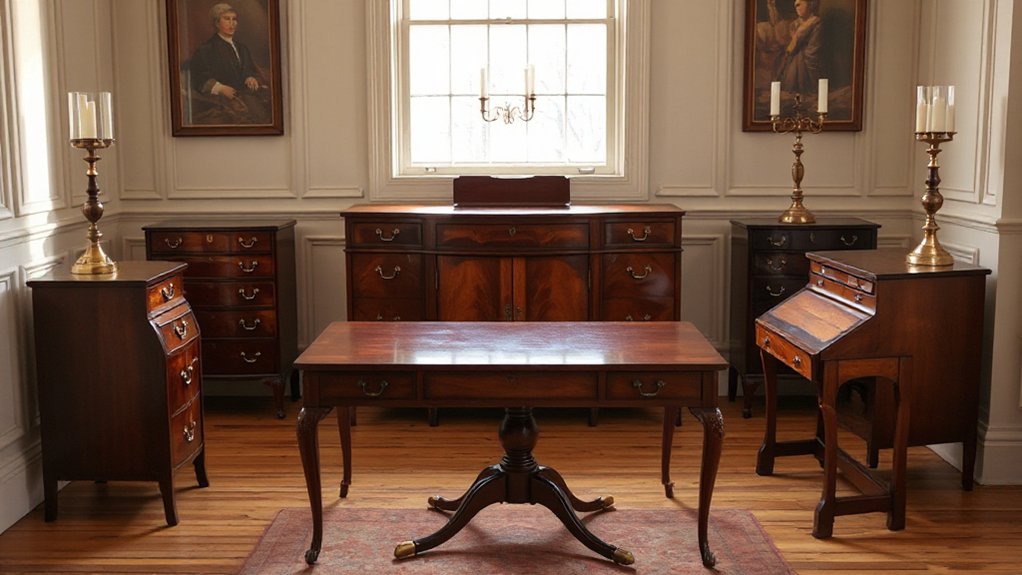
Now you’ll shift from legs and base profiles to the furniture forms that define Georgian rooms. You’ll spot signature table styles—tilt-top tea tables, gateleg and drop-leaf dining tables, and pedestal card tables—by their precise proportions, crisp moldings, and balanced symmetry. You’ll also recognize notable case piece types—highboys, lowboys, chests of drawers, and bookcases with paneled doors—through their architectural massing, refined cornices, and disciplined drawer layouts.
Signature Table Styles
Although Georgian furniture covers everything from grand case pieces to small accessories, its table forms give you the clearest read on the period’s priorities: balanced proportions, disciplined ornament, and everyday usability. You’ll see tilt-top tea tables with birdcage actions, tripod bases, and carved knees; they fold away yet still look composed. Drop-leaf Pembroke tables add flaps on hinged brackets, letting you shift from intimate use to entertaining without visual chaos. Console and pier tables keep shallow tops and crisp aprons to support mirrors and symmetry along a wall—ideal for Interior integration. If you’re tackling Furniture restoration, respect the original shellac glow and refined edge profiles.
- Feel the calm of perfect symmetry.
- Admire restraint that reads as luxury.
- Enjoy utility that never looks utilitarian.
Notable Case Piece Types
When you move from Georgian table forms to case pieces, you see the style’s engineering and hierarchy at full scale: tallboys and lowboys stack storage with crisp cornices and bracket feet; chests of drawers keep tight, graduated proportions; and bookcases and secretary bookcases balance glazed upper doors with solid lower cupboards for a disciplined, architectural elevation.
You’ll spot veneered walnut or mahogany laid in book-matched fields, with crossbanding that frames edges like molding. Look for fine cockbeading, stout dustboards, and half-blind dovetails that signal quality. In Interior design, place a tallboy to anchor a wall, or use a secretary as a functional focal point that hides paper clutter. For Antique restoration, stabilize drawer runners, preserve original hardware, and match period shellac rather than over-sanding—your case piece should read crisp, not newly minted.
How to Date Georgian Furniture and Style It Today
Because Georgian pieces span nearly a century of evolving taste, you’ll date them most accurately by reading their construction and ornament—think hand-cut dovetails, crisp mahogany veneers, bracket feet, and period-specific motifs like Palladian arches or neoclassical swags—then style them today by treating them as disciplined anchor pieces, pairing their symmetry and rich timber with quieter modern upholstery, clean-lined lighting, and a restrained palette that lets the craftsmanship stay in focus. Confirm age by checking secondary woods (oak, deal), uneven saw marks, and replaced brasses; later revivals feel machine-precise. For Modern decor integration, keep proportions generous, not cluttered, and let negative space do the work. Contemporary reinterpretations should echo profiles—reeded legs, satinwood inlay—without copying ornament.
- You’ll feel the calm of order.
- You’ll sense history, not heaviness.
- You’ll live with elegance daily.
Frequently Asked Questions
How Do I Distinguish Georgian Originals From High-Quality Reproductions?
You distinguish originals by checking tool marks, joinery, patina, and period hardware; you’ll verify provenance and wear consistency. For Antique authenticity and Reproduction identification, you’ll compare proportions, veneer grain, and restoration evidence under light.
What Are Typical Georgian Furniture Price Ranges at Auction?
At auction, you’ll typically see Georgian furniture from $800–$5,000 for smaller pieces, $6,000–$25,000 for case goods, and $30,000+ for signed rarities, reflecting antique market trends; use valuation techniques.
How Should I Clean and Maintain Georgian Shellac or Wax Finishes?
You should dust with a soft microfiber, wipe lightly with barely damp cloth, then dry. Use pH-neutral soap sparingly. Re-wax thinly, buff. Avoid silicone polishes. Care tips: stable humidity. Restoration techniques: consult conservator.
Which Certifications or Provenance Documents Matter When Buying Georgian Pieces?
You’ll want the papers first: then the proof. Prioritize authenticity verification via reputable appraisals, dealer invoices, and independent condition reports; demand provenance documentation like bills of sale, estate records, export permits, and restoration receipts. Avoid gaps.
How Can Georgian Furniture Fit Into Minimalist or Modern Interiors?
You can integrate Georgian furniture into modern decor by using one statement piece, keeping lines uncluttered, and balancing it with neutral textiles. You’ll achieve space optimization by selecting slim profiles, elevating pieces, and limiting accessories.
Conclusion
When you choose Georgian furniture, you’re choosing disciplined beauty: every curve answers a line, every ornament respects the whole. Look for balanced facades, classical motifs, rich mahogany or walnut, and hardware that feels purpose-built. Let patina speak; it’s the quiet proof of age. Style it with restraint—one bold piece, breathing room, clean sightlines. Like a well-drawn colonnade, symmetry leads your eye, and refinement keeps it there.