


With over 70% of homeowners wanting a better garden but avoiding major renovations, you’re not alone in seeking low-disruption improvements that still look deliberate and well-designed. By refining your planting structure, tightening sightlines, and upgrading surfaces, you can dramatically improve visual coherence and usability. Strategic tweaks to borders, containers, focal points, and circulation often outperform a full redesign—especially when you know which high‑impact changes to prioritize next…
Key Takeaways
- Refresh existing beds by top-dressing with compost, mulching uniformly, and editing or dividing plants instead of replanting everything.
- Use containers at entrances and junctions for instant color, height, and seasonal flexibility without disturbing established borders.
- Add a few strong focal points—like a sculptural pot, bench, or trellis—and simplify surrounding elements to clarify views.
- Improve comfort and usability by repositioning furniture, refining key paths, and adding basic, layered lighting for evenings.
- Tidy structure with repainted fences and trellises, clearer circulation, and small wildlife-friendly additions like log piles and dense shrubs.
Start With Quick Wins That Instantly Lift Your Garden
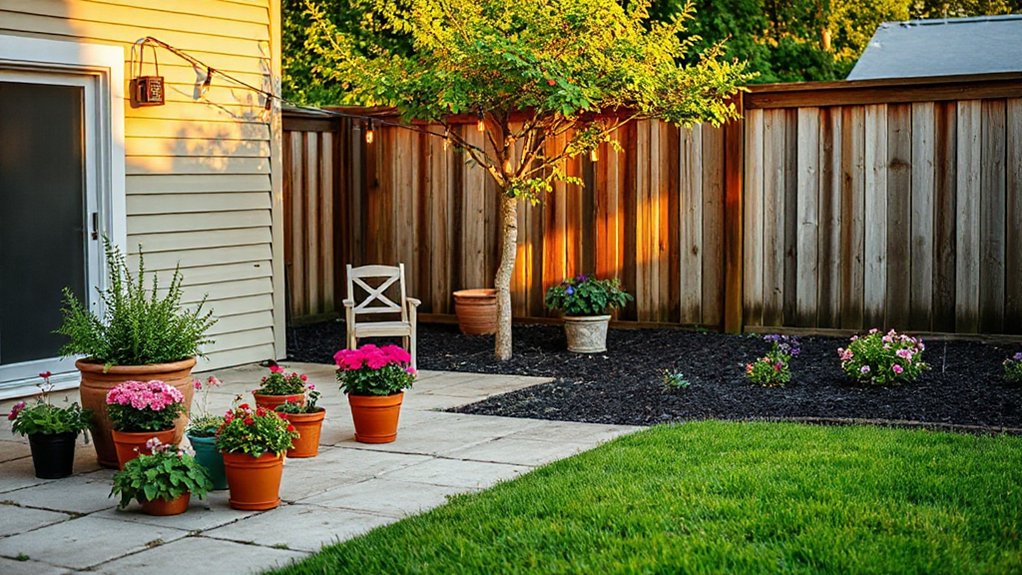
Although long-term projects define a landscape, you can generate immediate visual impact by targeting high-leverage elements that frame and organize the space. First, rationalize circulation: edge your main paths, clarify entrances, and align sightlines to a focal point such as a specimen tree, sculpture, or water feature. This instantly imposes visual order.
Next, assess vertical structure. Clean and repaint fences, trellises, and pergolas, then use them to anchor climbers and lighting. These plane-defining elements recalibrate proportion without heavy intervention.
Finally, optimize the interface between hardscape and garden soil. Top-dress visible beds, mulch uniformly, and integrate log piles or dense shrubs to enhance wildlife habitat. You’ll achieve a sharper aesthetic while quietly improving ecological function and long-term garden performance.
Refresh Beds and Borders Without Replanting Everything
Once you’ve tightened circulation and vertical structure, focus on the planting itself by upgrading beds and borders without stripping them back to bare soil. Start with soil enrichment: top-dress with compost, then mulch to unify surfaces, suppress weeds, and stabilize moisture. You’ll boost vigor without disturbing established root systems.
Next, refine composition. Edit out weak or congested plants, then divide and re-site healthy clumps to reinforce repeating rhythms and color echoes. Infill gaps with groundcovers that knit planting together and reduce bare patches that invite weeds.
Prune for structure, not just tidiness. Lift canopies, remove crossing stems, and expose key architectural forms.
Integrate species that support natural pest control, encouraging predators and pollinators to keep beds resilient and visually coherent.
Use Containers to Add Color, Height, and Flexibility
Two or three well-chosen containers can recalibrate your entire garden, injecting color, vertical emphasis, and seasonal adaptability without major restructuring. Treat pots as mobile architecture: they’re sculptural elements that also deliver foliage texture and bloom density.
Prioritize container placement at key junctions—path intersections, terrace edges, or bridges between hardscape and planting—to knit spaces together.
Use tall, narrow containers to introduce instant height where borders feel flat, pairing upright grasses or small shrubs with trailing underplanting to soften edges.
Deploy smaller vessels as colorful accents, repeating a limited palette of blooms and glazes to maintain visual coherence. Rotate seasonal compositions to refresh views, and group containers in staggered heights so each planting reads clearly without visual clutter.
Add Simple Focal Points and Features That Draw the Eye
Containers give you flexible framework; focal points give that framework a clear hierarchy. When you introduce a few decisive visual anchors, you organize the viewer’s gaze and make planting feel intentional, not accidental.
Prioritize focal point placement first, then edit surrounding elements to support it.
Use one dominant feature per view, supported by smaller accents to maintain visual balance and avoid clutter. Think in terms of contrast—form, color, texture, or scale—to make each feature read clearly against its background.
- A single sculptural pot in a restrained color palette
- An upright specimen shrub framed by lower planting
- A compact water bowl reflecting sky and foliage
- A vertical trellis or obelisk punctuating soft perennials
- A bold-colored bench terminating a sightline
Improve Comfort, Paths, and Lighting So You Use the Space More
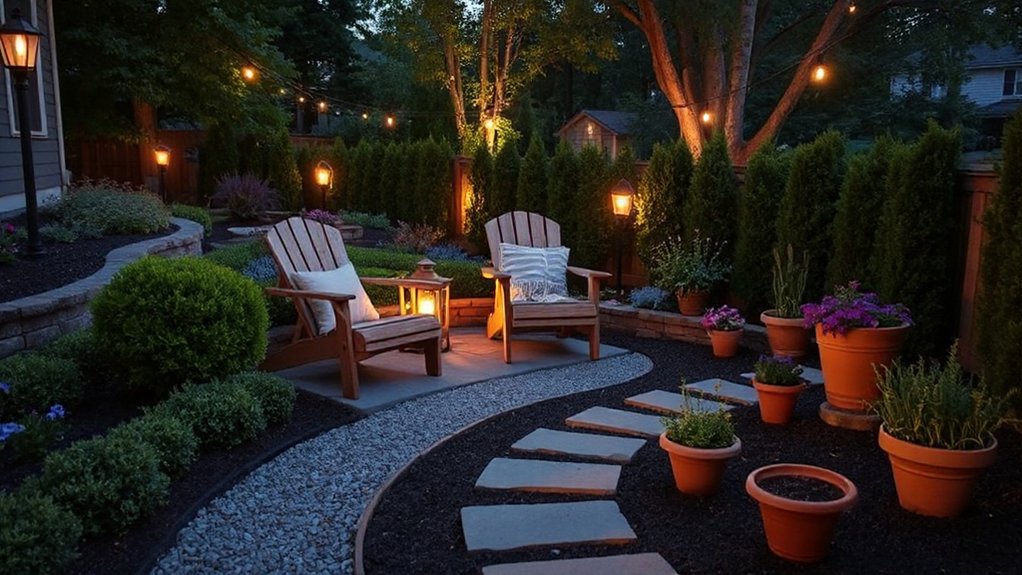
When you refine comfort, circulation, and lighting, your garden stops being a backdrop and starts functioning like an outdoor room you actually inhabit. Begin by evaluating garden ergonomics: seat height, back support, and proximity to tables determine how long you’ll linger. Add cushions and reposition furniture to capture views while avoiding glare or prevailing winds.
Next, rationalize circulation. Define primary paths with a consistent material, adequate width, and non-slip texture. Use secondary paths for incidental access, keeping curves gentle for intuitive wayfinding.
Integrate shade solutions—pergolas, shade sails, or deciduous trees—to modulate microclimate and protect seating.
Finally, layer lighting: low-level path markers for safety, warm wall or step lights for ambiance, and a few focused accents on key plants or structures.
Frequently Asked Questions
How Can I Improve a Small, Shady Garden Without Major Changes?
You enhance a small, shady garden by specifying shade tolerant plants, emphasizing layered foliage textures, and prioritizing container gardening for flexible microclimates. Introduce reflective surfaces, vertical trellises, and defined sightlines to optimize spatial perception and visual depth without structural alterations.
What Low-Maintenance Ideas Work Best for Busy or Beginner Gardeners?
You prioritize ultra-resilient perennials, mulch-intensive beds, and automated irrigation, then deploy container gardening modules and low-voltage garden lighting. You’ll minimize maintenance inputs while maximizing spatial efficiency, night-time usability, and long-term aesthetic coherence across your compact, high-performance landscape system.
How Can I Make My Garden Look Good Year-Round on a Budget?
You prioritize structural plants, staggered bloom times, and evergreen anchors, then integrate container planting for seasonal color and flexible layout. Add low-voltage garden lighting to highlight form, create depth, and guarantee your borders remain visually coherent year‑round.
What Simple Upgrades Will Help Attract More Wildlife and Pollinators?
You attract wildlife by diversifying structure and resources. Imagine installing clustered native planting beds, a small water dish, and modular insect hotels; you’d rapidly increase habitat complexity, nectar availability, and overwintering sites, boosting pollinator abundance and ecological resilience.
How Do I Choose a Cohesive Color Scheme for My Existing Garden?
You establish a cohesive color scheme by selecting a dominant hue, one accent, and a neutral, then applying color harmony principles, repeating plant pairing combinations, and controlling saturation, bloom times, and foliage tones for consistent visual rhythm.
Conclusion
When you layer these simple interventions, you don’t just “tidy up” your plot—you strategically upgrade its performance. Studies show well‑designed outdoor spaces can boost perceived property value by up to 20%, underscoring the impact of coherent planting, circulation, and lighting. By refining borders, curating containers, emphasizing focal points, and optimizing comfort, you’ll transform your garden into a cohesive, high-functioning landscape—without the disruption or expense of a full redesign.