


By coincidence, the proportions of your plot probably already echo the clean lines you want in a modern garden—you just haven’t mapped them yet. When you methodically survey the site, note sun angles, drainage patterns, and awkward dead zones, you’ll see where crisp axes, geometric beds, and low-maintenance planting can sit naturally. From there, the choice of layout, materials, and planting style becomes a highly strategic design exercise—if you structure it correctly.
Key Takeaways
- Measure and map your space, marking boundaries, structures, microclimates, and sightlines to understand constraints and opportunities before designing.
- Choose a simple geometric layout—grids, rectangles, or courtyards—and keep circulation direct, uncluttered, and aligned with key views.
- Select restrained hardscape materials with clean lines—concrete pavers, gravel, steel edging, or artificial turf—to define zones and reinforce a minimalist look.
- Build an architectural planting scheme using repeated forms—grasses, sculptural shrubs, and clipped evergreens—with a limited, cohesive color palette.
- Integrate sustainable features and finishing touches—rain gardens, composting, lighting, and modern furniture—so all elements read as one unified outdoor room.
Map Your Garden Space and How You’ll Use It

Before you sketch a single planting bed, you need a scaled map of your plot that captures boundaries, existing structures, utilities, and microclimates. Measure your site with a tape or laser measure, then transfer dimensions to graph paper or a digital drafting app. Mark house walls, fences, manholes, downspouts, and existing trees.
Next, overlay functional garden zoning. Delineate circulation corridors, seating nodes, production areas, and kid or pet zones. Note sun angles, prevailing winds, and drainage patterns; they’ll dictate where you can comfortably sit, grow edibles, or place a grill in hot Phoenix or damp Seattle.
Finally, plot outdoor privacy lines by recording sightlines from neighboring windows and upper decks, so you can later position screens and planting masses strategically.
Choose a Simple Modern Garden Layout That Fits
With your site map and functional zones defined, you can now select a modern garden layout that actually works on the ground. Start by choosing a strong geometric framework—rectilinear grids for narrow London terraces, offset rectangles for Los Angeles hillside plots, or a simple courtyard scheme for dense urban lots.
Prioritize Minimalist design: limit paths, keep circulation legible, and align planting beds with key sightlines from the house. Use repetition of forms and controlled negative space so the layout feels calm, not cluttered.
Integrate Sustainable features directly into the plan: orient beds for ideal solar gain, specify zones for rain gardens or bioswales, and place composting or water‑harvesting systems where access is efficient but visually discreet.
Pick Hardscape Materials for a Clean, Contemporary Look
Although plants set the mood, your hardscape materials ultimately define the garden’s contemporary character and day‑to‑day usability. Prioritize clean geometry, restrained palettes, and durable finishes that suit your climate—permeable concrete pavers in frost-prone New England, for instance, or large-format porcelain slabs in the Pacific Northwest’s wet winters.
Use hardscape to create crisp separations between zones:
- Install linear concrete pavers on a tight running bond to form low‑maintenance terraces and paths; specify saw‑cut edges and minimal joints for a monolithic look.
- Incorporate artificial turf in small, rectilinear panels where real lawn struggles—urban courtyards in Los Angeles or rooftop decks in Chicago.
- Combine gravel or decomposed granite with steel edging to frame beds, maintain sharp lines, and enhance drainage.
Select Modern Planting Styles and Low-Fuss Plants
Clean-lined hardscape gives you structure; planting completes the modern aesthetic and performance. You’ll want Contemporary plant palettes built around repetition, bold silhouettes, and restrained color.
Prioritize architectural forms: upright grasses, sculptural shrubs, and clipped evergreens. In temperate regions like the Pacific Northwest or UK, combine Hakonechloa, boxwood domes, and multi-stem birch for rhythm and contrast.
In hot-summer climates—California, the Mediterranean, Australia—specify drought-tolerant, minimal maintenance greenery: Lomandra, Westringia, olive, and Agave or Aloe as focal points.
Use matrix planting: a dominant grass layer (e.g., Sesleria, Pennisetum), interplanted with flowering perennials such as Salvia or Gaura for seasonal interest.
Limit your palette to three to five core species per zone to keep lines legible and maintenance predictable.
Add Lighting, Furniture and Finishing Touches for Cohesion
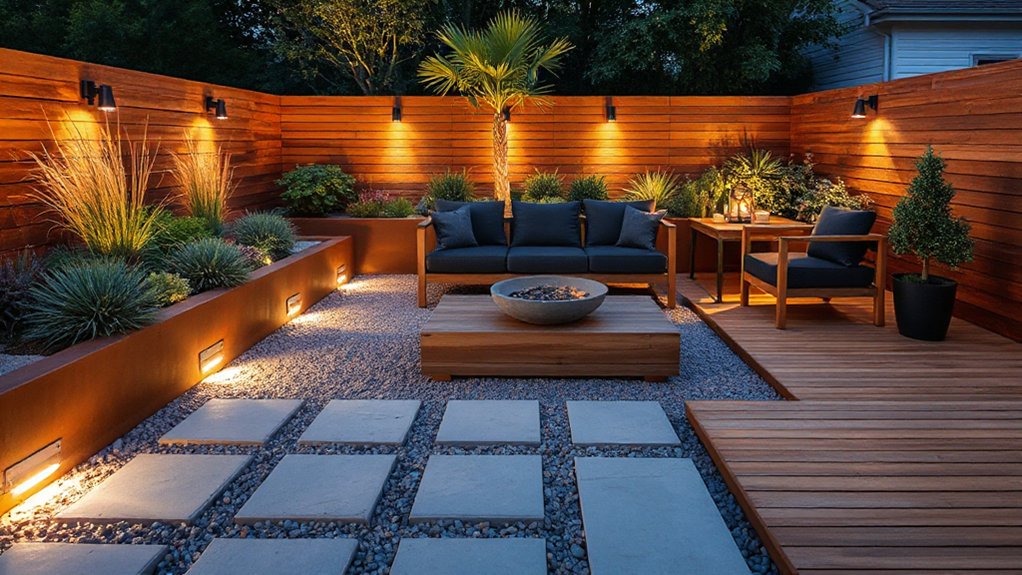
Once your planting framework reads clearly, you calibrate lighting, furniture, and details so the garden functions as a unified outdoor room rather than a collection of elements. Start by zoning circulation and seating, then layer ambient, task, and accent lighting. In temperate climates like the Pacific Northwest, prioritize low‑glare, IP‑rated fixtures and warm color temperatures for year‑round usability.
- Define structure with a restrained furniture palette—powder‑coated aluminum, FSC hardwood, or concrete to echo modern architectural lines.
- Introduce garden art as focal points, aligning sculptures or wall pieces with primary sightlines from the house.
- Edit outdoor accessories—textiles, planters, lanterns—to a tight color story, repeating metals and hues to visually stitch paving, planting, and façades into one coherent composition.
Frequently Asked Questions
How Much Does a Modern Garden Layout Typically Cost to Create From Scratch?
You’ll typically spend $20–$60 per square foot in most U.S. regions, depending on soil remediation, hardscape intensity, and irrigation. Budget considerations hinge on material specifications, while modular planting schemes and phased implementation increase design flexibility and long‑term cost control.
How Long Does It Take to Establish a Modern-Style Garden?
You’ll typically establish a modern-style garden in 1–3 growing seasons, depending on plant selection and design principles; in temperate regions like the Pacific Northwest, remember “Rome wasn’t built in a day” for full structural maturity.
Can I Design a Modern Garden in a Small Balcony or Rooftop Space?
You absolutely can. Treat vertical surfaces as primary planes, maximize Balcony greenery with modular planters, and specify drought-tolerant species. In dense cities like NYC or London, you’ll engineer drainage, windbreaks, and weight loads to create a resilient Urban oasis.
What Maintenance Schedule Suits a Modern Garden With a Busy Lifestyle?
You’ll follow a weekly light-maintenance schedule: choose low-input plant selection (native perennials, drought-tolerant succulents), automate irrigation systems with drip and timers, perform monthly pruning, quarterly soil amendments, and seasonal pest monitoring tailored to your climate zone and rainfall patterns.
How Can I Adapt a Modern Garden Design for Pets and Children?
You weave safety into style by zoning robust turf, specifying Pet friendly plants like lavender and rosemary, and integrating Child safe features—rounded Cornish granite edging, non-slip sandstone paving, secure boundary fencing, and screened water elements compliant with UK RoSPA guidelines.
Conclusion
You’ve seen how to map your plot, streamline circulation, and layer hardscape and planting for a crisp, modern look. In fact, well‑designed landscapes can boost perceived property value by up to 15%, according to UK estate surveys. So whether you’re working with a tight London courtyard or a sprawling California backyard, apply clean geometry, drought‑resilient palettes, and integrated lighting to build a contemporary garden that’s as functional as it is future‑proof.